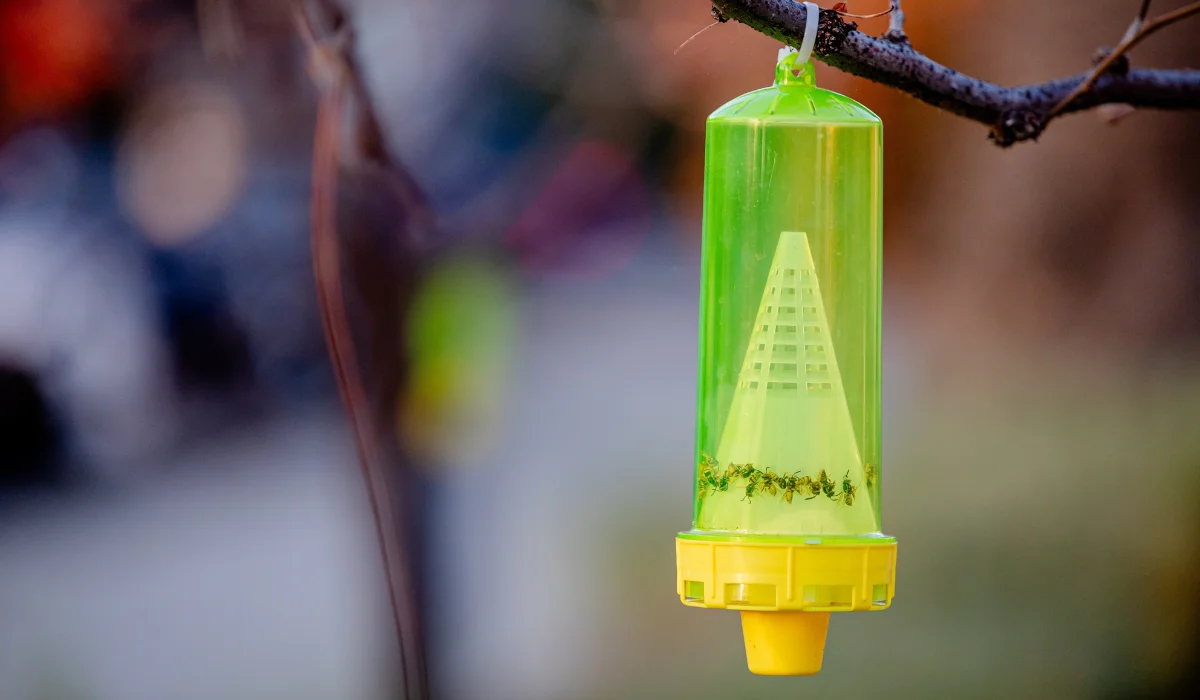
A yellow jacket trap can reduce some wasp activity around your yard, but the location determines whether that activity stays away from people or passes directly through the space you are trying to protect. Hang a yellow jacket trap beside a patio, grill, doorway, or play area, and you may draw foraging wasps toward the exact place where your family spends time.
The better approach is to place the trap outside the occupied part of the yard, along a route yellow jackets already use while searching for food. Keep it away from outdoor meals, garbage, pet areas, and busy walkways, and follow the manufacturer’s directions for placement, height, and lure replacement.
For homeowners in West Michigan, proper yellow jacket trap placement becomes especially useful in late summer and fall, when activity is easier to notice. Traps can reduce some close encounters, but they do not reliably eliminate a mature nest hidden underground or inside a wall.
Yellow Jacket Trap Placement Determines Where Wasps Gather
A yellow jacket trap does not form a protective barrier around your patio. It works by attracting foraging yellow jackets to one location, so you need to think about the route they will take to reach it.
If you hang the trap beside the deck, it may catch wasps while still increasing traffic through the seating area. The same problem can occur near a back door, grill, picnic table, pool, or children’s play equipment. A trap can appear effective because insects are entering it, even though more yellow jackets are now moving through an occupied space.
Good yellow jacket trap placement moves that activity away from people. The trap should sit beyond the area you want to use, not inside it. It should also be easy to inspect without forcing you to cross an active flight path.
Think in Yard Zones, Not One Exact Distance
There is no single distance that fits every trap design, property, or manufacturer’s instructions. A small urban yard, a rural property, and a commercial outdoor space each require a different layout.
Dividing the property into zones makes placement easier:
| Yard Zone | Common Features | Trap Guidance |
|---|---|---|
| Occupied zone | Doors, patios, grills, seating, play equipment, pet areas | Avoid placing traps here |
| Transition zone | Open lawn, garden edges, occasional walkways | Use caution and watch traffic patterns |
| Outer zone | Fence lines, quiet landscape edges, low-traffic perimeter areas | Often the best starting point |
The outer zone usually provides the strongest balance between access and separation. Compare that location with the product directions, since trap designs differ in recommended height, weather exposure, and spacing.
Where to Hang a Yellow Jacket Trap Around Your Yard
The best place for a yellow jacket trap is away from doors, windows, outdoor dining areas, and narrow paths. Choose a location where the trap can attract foragers without pulling them through the center of your yard.
Look for a spot near existing yellow jacket activity, but not directly beside a nest entrance. A trap may perform better near a route the wasps already use, such as the outer edge of a landscape bed, the far side of a fence, or a quiet section of the yard where they repeatedly pass.
Access matters too. Place the trap where you can inspect it or replace the lure without standing over a ground opening, reaching into dense shrubs, or walking through heavy wasp traffic. Avoid locations where a lawn mower, children, pets, or routine yard work may knock it down.
Watch Flight Paths From a Safe Distance
Yellow jackets that repeatedly enter one ground hole, gap in siding, opening under a roof edge, or crack near masonry are not simply wandering through the yard. Consistent movement into one opening may indicate an active yellow jacket nest.
Observe from a safe distance and look for a repeated line of travel. Do not stand near the opening or block the route. If several wasps begin circling you or responding defensively, leave the area.
In Michigan, yellow jackets may nest in the ground, inside wall voids, and around protected areas near homes. Accurate identification matters because a trap placed for scattered foragers will not solve the same problem as a colony beside a door, sidewalk, deck, or play area.
Trap Locations That Can Increase Close Encounters
One of the most common mistakes is hanging a yellow jacket trap over or beside a picnic table. The trap may catch some wasps, but it also adds another attraction point near food, drinks, and people.
Doorways create another poor placement area. People move through them frequently, and children or pets may stop near the threshold. A trap beside the door can bring yellow jackets into a tight space where both people and wasps have limited room to move.
Garbage and recycling areas can also interfere with trapping. Food residue, open cans, sugary drink containers, and uncovered waste may compete with the lure. In that setting, moving the trap a few feet may not solve the larger attraction problem.
Fruit trees, fallen fruit, hummingbird feeders, and pet food can create similar competition. Yellow jackets may ignore the trap when a stronger food source is nearby. Clean up spills, remove fallen fruit, rinse recycling, cover garbage, and move pet food indoors before assuming the yellow jacket trap bait has failed.
Narrow walkways are another poor choice. A trap mounted along a side path, gate, or passage between a fence and the house can force people through the same space where yellow jackets are gathering.
Why Yellow Jacket Trap Bait Still Matters
The title does not mean bait is irrelevant. A well-placed trap will not perform well if the local yellow jacket species does not respond to the lure.
The University of California Integrated Pest Management guidance on yellow jackets explains that lure performance differs among species. Some attractants work well for certain yellow jackets but do not draw every species equally.
Season also affects feeding behavior. Yellow jackets collect animal protein for developing larvae during much of the season. Later, workers often become more noticeable around sweet foods and drinks as colony needs change. That shift helps explain why a lure that worked earlier may seem less effective later, or why a yellow jacket chooses an open soda can over a nearby trap.
Nearby food can overpower the lure. Old, dried, diluted, or contaminated bait may also perform poorly. Follow the manufacturer’s instructions for lure selection, replacement timing, and trap maintenance rather than relying on one homemade recipe throughout the season.
Homemade Bait Does Not Work the Same Everywhere
A homemade mixture may catch yellow jackets in one yard and perform poorly in another. Different species respond to different attractants, and changing food preferences can affect results from one month to the next.
Placement and bait need to work together. The right location keeps yellow jacket traffic away from people, while the right lure gives the trap a better chance of attracting the species present on the property.
What Yellow Jacket Traps Can and Cannot Do
A yellow jacket trap can capture some foraging adults and reduce activity in a limited area. It can also help confirm that yellow jackets are present and support other steps, such as cleaning garbage areas and removing exposed food.
What a trap cannot reliably do is eliminate a mature colony hidden underground or inside a wall. It removes individual workers, but the nest may continue sending out more foragers.
The University of Minnesota information on wasps and bees notes that some mature yellow jacket colonies can reach an upper range of about 5,000 individuals. Not every nest grows that large, but the figure shows why catching scattered workers does not necessarily remove the source of the activity.
A trap also cannot make an active nest safe to approach. Yellow jackets are social wasps that defend a shared colony, and females can sting more than once. Several workers may respond when people, pets, lawn equipment, or yard tools disturb the nest area.
Think of a trap as one part of a larger approach. Sanitation, careful observation, proper placement, and professional nest management may all be needed depending on the source of the activity.
When Trap Placement Is No Longer the Main Problem
A steady stream of yellow jackets entering one opening points to a nest concern rather than a simple trap-placement problem. Common nest sites include underground burrows, landscape timbers, wall voids, sheds, attics, retaining walls, and hollow trees.
The University of Kentucky’s yellow jacket guidance explains how colonies grow through spring and summer and become more noticeable later in the season. By that point, repeated activity beside a walkway, patio, entrance, or play area can interfere with normal use of the property.
Do not seal a structural opening while yellow jackets are actively entering it. Wasps trapped inside a wall may search for another exit and move into the building.
Professional evaluation makes sense when you see repeated traffic into one ground or structural opening, defensive behavior during mowing, activity beside a high-use area, or continued heavy activity despite sanitation and properly placed traps. A known sting allergy in the household is another reason to avoid close inspection or DIY nest work.
Using Yellow Jacket Traps More Safely in West Michigan
A yellow jacket trap works best when you place it outside the space you want to protect. Keep it away from doors, patios, outdoor meals, play areas, and busy walkways. Remove competing food sources, follow the product directions, and treat repeated traffic into one opening as a possible nest.
Bait still matters, but location controls where attracted yellow jackets gather and how they move across the property. A strong lure in the wrong spot can create more close encounters instead of fewer.
When yellow jackets are nesting near your Kalamazoo or Grand Rapids home, Pest Pros of Michigan can identify the activity, locate the source, and recommend a practical control plan. To schedule an inspection, contact the Pest Pros team before activity spreads into a high-use part of your property.

 Serving Michigan since 2018
 Pest-free guarantee
 Small, local business
 10+ years of pest control experience
 President and CEO of Pest Pros of Michigan
 Resident of Michigan