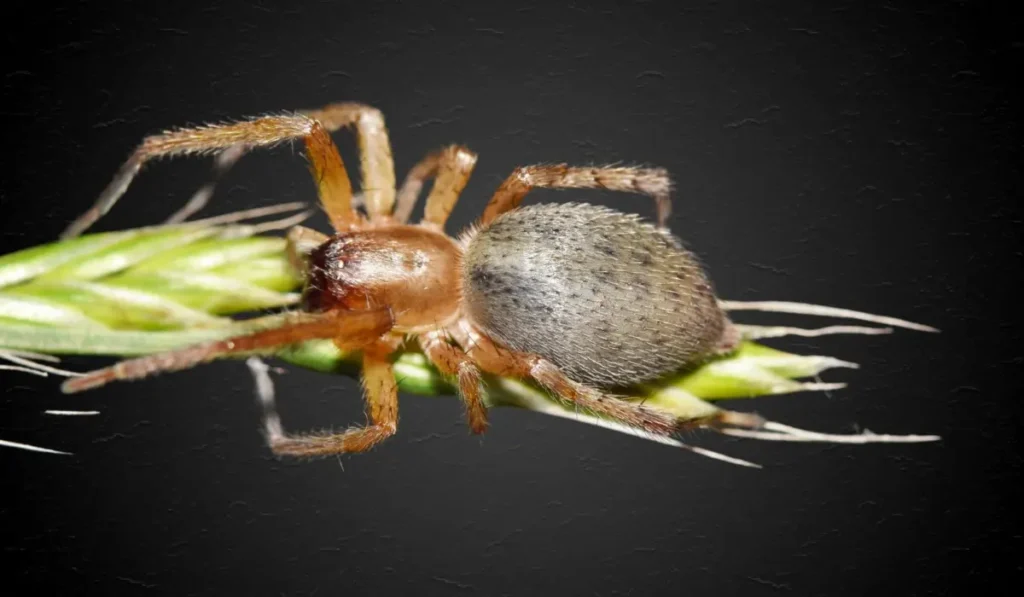
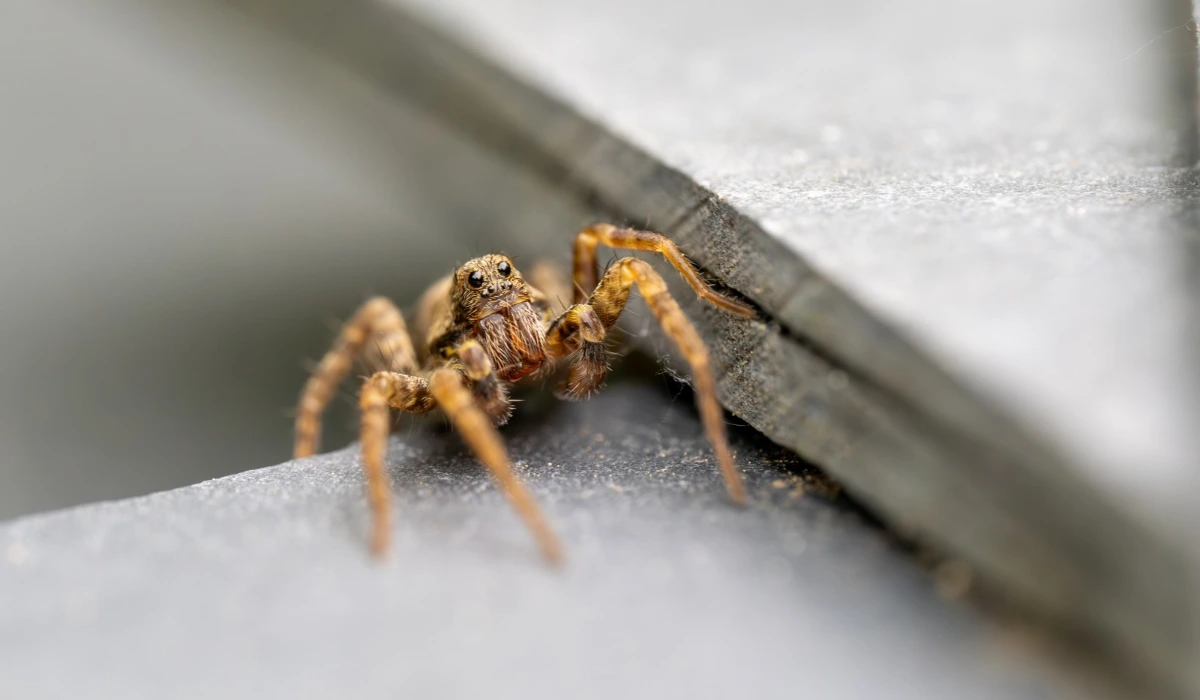
Michigan has several types of wolf spiders, from large ground hunters to smaller spiders that move through lawns, fields, and leaf litter. Most have brown, gray, tan, or mottled coloring, so appearance alone can be misleading. The best identification clues are their distinctive eye pattern, active hunting style, and the way females carry egg sacs and later transport spiderlings on their backs. Knowing those traits also makes it easier to separate wolf spiders from fishing spiders and grass spiders that may look similar around Michigan homes.
Types of Wolf Spiders in Michigan You May Encounter
Wolf spiders belong to the family Lycosidae. They vary considerably in size and markings, which makes broad homeowner categories more useful than trying to assign an exact species from a quick photo.
Around Michigan properties, you may encounter larger ground-dwelling wolf spiders, medium-sized spiders moving through grassy or wooded areas, and smaller runners that are easy to overlook. All share the basic characteristics of the wolf spider family even though their size, pattern, and preferred habitat differ.
Large Ground-Dwelling Wolf Spiders
Large wolf spiders have sturdy bodies, long running legs, and earth-toned coloring that blends with soil, mulch, leaf litter, and other ground cover. Instead of sitting in a large prey-catching web, they move across the ground in search of insects and other small prey.
These are the spiders most likely to attract attention when one crosses a garage or basement floor. Their size can make them look threatening, but size tells you little about how likely a spider is to interact with people.
A large brown spider is not enough for a species-level identification. Fishing spiders and other groups can overlap in general size and color, so eye arrangement and behavior are more dependable starting points.
Medium-Sized Field and Woodland Wolf Spiders
Medium-sized wolf spiders occur in places where ground cover and prey are available, including grassy areas, open soil, leaf litter, and woodland edges. Their brown, gray, or tan patterns help them disappear against the surface beneath them.
Like larger members of the family, these spiders hunt on foot. You may not notice one until it runs across bare ground, a patio, or another open surface.
Many spiders in Michigan share muted brown and gray coloring. That makes color useful as a supporting feature, but a poor basis for identification by itself.
Smaller Running Wolf Spiders
Wolf spiders are not always large. Smaller types move through lawns, fields, and other open ground where their size and camouflage make them much less noticeable.
They still have the characteristic Lycosidae eye pattern and the active hunting behavior associated with the family. A small spider can therefore be just as much a wolf spider as the larger specimens that tend to get more attention indoors.
Exact species identification is a separate question. Closely related wolf spiders can require details that are difficult to see in a casual photograph, so genus- or family-level identification is often more realistic for homeowners.
How to Identify a Michigan Wolf Spider
If you want to know whether a brown spider is a wolf spider, start with the eyes. University of Kentucky Department of Entomology materials describe wolf spiders as having eight eyes arranged in three rows, with two prominent eyes in the middle row.
That arrangement is more useful than matching body color to a photograph. Stripes and mottled patterns vary, while the eye pattern is a family-level feature.
Check the Eye Pattern
Viewed from the front, the two large middle eyes are the easiest feature to notice. Smaller eyes sit in the other rows around them.
There is no reason to move close to a live spider to inspect this feature. A clear photo taken from a comfortable distance may show enough detail to help with identification.
The spider’s movement adds another clue. Wolf spiders often run across soil, leaves, patios, garage floors, or basement floors while hunting. They do not depend on the broad sheet-and-funnel capture webs built by grass spiders.
Watch for an Egg Sac Behind the Female
Female wolf spiders carry their egg sacs attached to the spinnerets at the rear of the abdomen. Because the female continues moving with the sac attached, homeowners sometimes mistake it for debris or something caught on the spider.
Penn State Extension spider-identification materials describe this egg-carrying behavior as characteristic of wolf spiders. Seeing a female running with a rounded sac attached behind her is therefore a useful identification clue.
This behavior also separates wolf spiders from many other spiders that leave egg sacs in a fixed web, retreat, or sheltered location.
Look for Spiderlings on Her Back
After the young hatch, wolf spiderlings climb onto the female and ride on her abdomen for a period. A female carrying young may look unusually textured until you see that the surface is covered with tiny spiders.
This is one of the clearest behavioral signs of a wolf spider. If you see a mobile female carrying a cluster of spiderlings on her back, the identification is much stronger than one based only on brown coloring or body size.
Wolf Spider vs. Fishing Spider vs. Grass Spider
Fishing spiders and grass spiders account for some of the confusion around wolf spider identification. All three groups can include brown or gray spiders, but their behavior and anatomy provide better ways to tell them apart.
| Feature | Wolf Spider | Fishing Spider | Grass Spider |
| General appearance | Brown, gray, tan, or mottled; often sturdy-bodied | Often large, brown, and long-legged | Brown or gray, often with visible striping |
| Hunting method | Actively hunts prey | Actively hunts prey | Uses a sheet web with a funnel retreat |
| Typical setting | Ground, lawns, leaf litter, and areas near foundations | Many occur around water or damp habitats | Grass, shrubs, foundations, and other sites suited to funnel webs |
| Strong identification clue | Three-row eye arrangement | Body form plus habitat and eye features | Funnel web and elongated spinnerets |
Wolf Spider vs. Fishing Spider
Fishing spiders belong to the family Pisauridae. They can be large, long-legged, and brown, so a quick view may not separate them from a large wolf spider.
Many fishing spiders are associated with water or damp habitats. A specimen found around a pond, dock, shoreline, or similar setting may fit that group, but habitat should support the identification rather than decide it.
When you can see the eyes safely, the wolf spider’s Lycosidae eye pattern becomes much more useful. Without enough detail, a broad identification is better than forcing a species name from color and location.
Wolf Spider vs. Grass Spider
Grass spiders belong to the funnel-weaver family Agelenidae. Their webs provide one of the easiest homeowner distinctions.
A grass spider builds a flat or slightly curved sheet of silk that narrows into a funnel-shaped retreat. The spider stays near the funnel and responds when prey lands on or crosses the web.
Wolf spiders hunt without relying on that type of capture web. Grass spiders can also show elongated spinnerets projecting from the rear of the abdomen, another useful feature when the spider itself is visible.
Are Wolf Spiders in Michigan Dangerous?
Wolf spiders are usually a nuisance encounter rather than a dangerous household pest. Their normal behavior is to hunt small prey and retreat from larger threats.
Like other spiders, they may bite defensively if handled or trapped against the skin. Avoid picking up an unknown spider with bare hands, especially when you can simply give it room to move away or remove it using a container.
If a suspected spider bite causes a severe or unusual reaction, seek medical advice. Symptoms alone are not a reliable way to determine which spider caused a bite.
Why Wolf Spiders Show Up in Basements and Garages
Wolf spiders spend most of their time outdoors, but ground-level openings can lead them into garages, basements, and other parts of a home. A spider moving along a foundation may find a gap under a door, around a basement window, or beside a utility line.
Seasonal changes in Michigan spider activity can make indoor sightings more noticeable at certain times of year. Wolf spiders are different from insects that gather on buildings specifically to overwinter inside. An indoor wolf spider is often better understood as a wandering outdoor predator that found an opening.
Basements and garages may also provide cover and insect prey. Those conditions can allow a spider that wandered indoors to remain there longer.
Inspect the Entry Points Closest to the Ground
Start with the openings a ground-running spider is most likely to reach:
- Exterior door thresholds
- Worn door sweeps
- Garage-door edges
- Basement windows
- Foundation gaps
- Openings around utility lines
Repeated sightings in one room can narrow the search. If spiders regularly appear near the same basement wall or garage corner, inspect the matching exterior area for accessible gaps.
Treat Moisture as a Prey Issue
Humidity by itself should not be treated as a wolf spider magnet. The more useful connection is what damp conditions may support.
Leaks, wet storage areas, and persistently humid spaces can support small insects. Those insects become prey for spiders, which can make the area more favorable after a wolf spider wanders inside.
That is one reason spider activity in Michigan basements often makes more sense when you look at the entire environment. Moisture, prey insects, hiding places, and entry gaps can all contribute to what you are seeing.
How to Keep Wolf Spiders Out of Your Michigan Home
Start with exclusion. Since wolf spiders move along the ground, doors, garages, basement windows, and foundation-level openings deserve the first inspection.
Then look at the conditions inside. Reducing prey insects and unnecessary hiding places makes a basement or garage less supportive for spiders that get through.
Close the Openings You Can Reach
Check door sweeps and weather stripping for wear. Repair damaged screens and inspect gaps around basement windows, utility penetrations, and garage doors.
Use previous sightings to guide the work. A spider repeatedly appearing near one wall gives you a more useful starting point than trying to seal every tiny opening around the entire house.
Focus on obvious access points that connect outdoor ground habitat with interior spaces. Those repairs can reduce spider entry while also helping with other crawling pests.
Reduce Prey and Hiding Places
Fix leaks and keep stored materials dry. Organize boxes and other items so you can inspect along walls, corners, and floors without moving piles of belongings.
Outside, remove unnecessary debris that sits directly against the foundation and keep the immediate perimeter accessible enough to inspect. The purpose is not to strip the landscaping bare. You want to make entry points easier to see and reduce dense, undisturbed hiding areas right against the structure.
When insect activity is also high, addressing those pests can reduce the food available to wandering spiders.
When Professional Spider Control Makes Sense
One wolf spider in the garage usually does not point to a larger problem. Repeated sightings, numerous spiders around the exterior, difficult-to-reach entry points, or steady insect activity are stronger reasons to consider professional service.
Pest Pros of Michigan includes spiders in its residential Home Pro service options. Some plans focus on exterior service, while others allow or include interior service depending on the plan.
Professional service is most useful when it addresses why spiders keep appearing. That may involve exterior activity, prey insects, recurring entry routes, or parts of the structure that are difficult to inspect safely from the ground.
Keeping Wolf Spiders Outside in Michigan
The types of wolf spiders in Michigan vary enough that “large brown spider” is not a useful identification by itself. Look instead at the three-row eye arrangement, active hunting behavior, egg sacs carried behind females, and spiderlings riding on the mother’s back. Fishing spiders and grass spiders may look similar, but their habitat, web use, and physical features provide better ways to separate them.
If wolf spiders keep appearing in your basement, garage, or other indoor spaces, start with accessible ground-level gaps, moisture problems, hiding places, and the insects they hunt. Pest Pros of Michigan can assess recurring spider activity around West Michigan homes. If exclusion and basic maintenance are not solving the problem, contact Pest Pros of Michigan to request service.

 Serving Michigan since 2018
 Pest-free guarantee
 Small, local business
 10+ years of pest control experience
 President and CEO of Pest Pros of Michigan
 Resident of Michigan