You see wasps slipping beneath the siding, circling the eaves above your garage, or flying in and out of a hole beside the lawn. The wasps of Michigan include social species that defend shared colonies and solitary species that usually spend their time hunting prey or building individual nests.
You can often tell what you are dealing with by looking at body shape, nest location, and flight activity. This guide covers the most common types, when they appear around Michigan homes, how their nests differ, and when activity near your house may call for professional attention.
Common Wasps of Michigan Around Homes and Yards
Michigan wasps, sorted by what the nest calls for
Social colonies and solitary hunters get lumped together as one yellow-and-black threat. Here is how the common wasps of Michigan differ by nest and behavior, and how much each one actually calls for action.
Yellow Jacket
DefensiveCompact body with strong yellow and black markings.
Where Ground cavities, wall voids, landscaping, and structural gaps.
Bald-Faced Hornet
DefensiveMostly black with clear white markings.
Where Enclosed gray paper nest in trees, shrubs, or on structures.
Paper Wasp
StingsSlender body with long legs that often hang in flight.
Where Open comb beneath eaves, rails, soffits, and sheltered ledges.
Mud Dauber
SolitaryNarrow waist and long dark or metallic body.
Where Mud chambers on walls, garages, sheds, and ceilings.
Cicada Killer
SolitaryLarge black-and-yellow body.
Where Individual burrows in sunny or loose soil.
The common wasps of Michigan do not all behave the same way around people. Yellow jackets, paper wasps, and bald-faced hornets live in social colonies. Mud daubers and cicada killers are solitary, so their nesting behavior looks quite different.
For practical Michigan wasp identification, start with what the insect looks like and where it keeps returning.
| Type | What You May See | Typical Nest Location | Behavior Near the Nest |
| Yellow jacket | Compact body with strong yellow and black markings | Ground cavities, wall voids, landscaping, structural gaps | Can strongly defend the colony |
| Paper wasp | Slender body with long legs that often hang in flight | Open comb beneath eaves, rails, soffits, and sheltered ledges | Usually less troublesome away from the nest |
| Bald-faced hornet | Mostly black with clear white markings | Enclosed paper nest in trees, shrubs, or on structures | Defensive close to the colony |
| Mud dauber | Narrow waist and long dark or metallic body | Mud chambers on walls, garages, sheds, and ceilings | Solitary and generally less defensive |
| Cicada killer | Large black-and-yellow body | Individual burrows in sunny or loose soil | Solitary and usually avoids people |
Yellow Jackets and Paper Wasps
Yellow jackets in Michigan can be difficult to spot because the colony may sit underground or inside a structure. You may notice workers using the same opening beside the foundation, moving through a gap in siding, or flying low over one section of the yard.
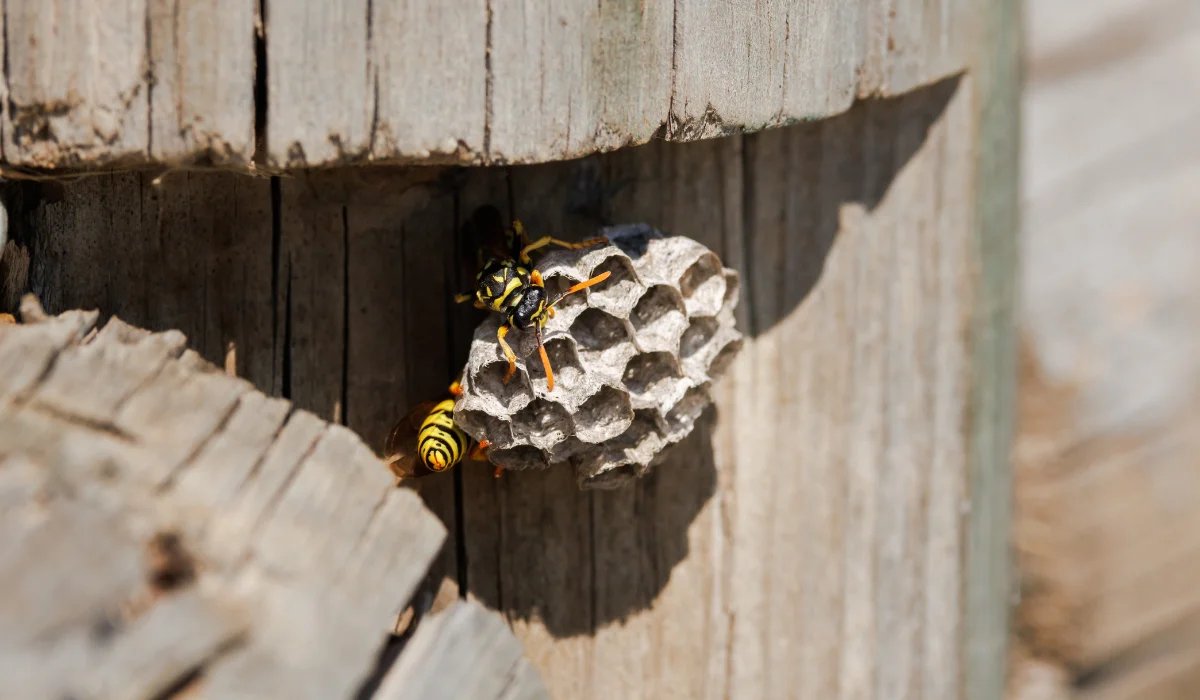
Paper wasps make a more visible nest. Their uncovered paper combs commonly hang beneath roof edges, porch ceilings, railings, and other protected surfaces. If you can see the individual cells from below, you are likely looking at a paper wasp nest.
Bald-Faced Hornets, Mud Daubers, and Cicada Killers
Bald-faced hornets are wasps despite their common name. Their nests are covered in a gray paper material and often hang from tree branches, shrubs, rooflines, or other elevated surfaces.
Mud daubers build with mud rather than paper and collect spiders for their young. Cicada killers dig individual burrows and hunt cicadas. Both are solitary wasps, so several insects in one area do not automatically mean a large defensive colony is present.
How to Identify Nests Built by Wasps of Michigan
Watching where the insects travel is often more useful than trying to identify one while it is flying. Repeated movement to the same opening gives you a clue about both the species and the type of nest.
Nest construction varies enough that you can often narrow down the possibilities without approaching closely.
| What You Notice | Possible Wasp | Useful Clue |
| Many small wasps entering one hole in the lawn | Yellow jackets | One shared underground entrance |
| Several large wasps using separate soil holes | Cicada killers | Individual burrows |
| Open paper comb with visible cells | Paper wasps | No outer covering |
| Gray enclosed nest hanging from a branch | Bald-faced hornets | Covered aerial nest |
| Hardened mud tubes or chambers | Mud daubers | Nest made from mud |
| Wasps repeatedly disappearing beneath siding | Often yellow jackets | Colony may be inside a structural void |
Ground Nests
An underground wasp nest can remain unnoticed until you mow, walk, or work close to the entrance. Yellow jackets usually send many workers through the same opening, so repeated traffic to one small spot is worth watching from a safe distance.
Cicada killer activity has a different pattern. Several females may use the same sunny patch of soil, but each works from her own burrow. Their size can draw your attention before their behavior does.
Wall Voids and Eaves
A wasp nest in a wall can be harder to evaluate because you only see the entrance. Workers may disappear beneath siding, soffits, trim, or gaps around utility lines while the main colony remains hidden farther inside.
A wasp nest under eaves is easier to inspect visually, especially when paper wasps build an exposed comb. Do not seal an active wall opening while insects are still using it because they may search for another route through the structure.
When Wasps Are Most Active in Michigan
The activity of wasps in Michigan changes sharply through the year. Social colonies begin small in spring, grow during summer, and become easier to notice as worker numbers increase.
A queen starts the nest and raises the first workers. Those workers take over much of the foraging, nest building, and feeding as the colony expands.
The University of Minnesota Extension explains that social wasp colonies in northern climates are annual. New queens survive the winter in protected locations, while the workers and the previous queen die as cold weather sets in.
| Time of Year | What You Are Likely to Notice |
| Spring | Queens begin new nests |
| Early summer | Small colonies grow and workers begin foraging |
| Mid to late summer | Nest traffic and worker numbers increase |
| Early fall | Large colonies remain active and food-seeking becomes more noticeable |
| Late fall | Worker numbers decline with colder weather |
| Winter | New queens remain sheltered until the next season |
A nest that seems to appear suddenly in August may have been developing for months. By late summer, more workers are traveling between the colony and food sources around lawns, gardens, garbage areas, patios, and outdoor dining spaces.
Old paper nests do not become permanent homes for the same colony. A new queen starts a fresh nest the following year, although sheltered areas around a home may attract nesting again.
How Much Risk Do Wasps of Michigan Create?
The level of risk depends more on nest location and colony behavior than on the size of the insect. A single wasp feeding on flowers presents a very different situation from a social colony beside the deck stairs.
Yellow jackets, paper wasps, and bald-faced hornets can sting repeatedly. A wasp sting often causes localized pain, redness, and swelling, but serious allergic reactions can occur.
A Centers for Disease Control and Prevention (CDC) report on deaths from hornet, wasp, and bee stings recorded 788 deaths in the United States from 2011 through 2021, or an average of about 72 deaths per year. Men accounted for 84% of the deaths. Those figures combine bees, hornets, and wasps nationwide and should not be read as a Michigan-specific count.
Difficulty breathing, faintness, dizziness, or swelling away from the sting site can indicate a severe allergic reaction. Seek emergency medical care when those symptoms occur.
Social Wasps Versus Solitary Wasps
Social wasps live with other adults that help maintain and defend one colony. Yellow jackets, paper wasps, and bald-faced hornets fall into this group.
Mud daubers and cicada killers do not maintain a large shared worker population. A female can still sting if handled or threatened, but the group-defense behavior associated with a social colony is absent.
That difference helps explain why size can be misleading. A large cicada killer flying across the lawn may look intimidating, while a much smaller yellow jacket colony hidden beside a walkway can create the more difficult situation.
When Wasp Nest Removal Makes Sense
Not every nest requires removal. The decision should depend on where the nest is located, which species built it, and how often you have to pass through the area.
A mud dauber nest high inside a shed may never interfere with you. A yellow jacket entrance beside a garage door, deck step, mower path, or children’s play area is much harder to avoid.
Nests Near Daily Activity
Pay attention to colonies near doors, patios, sidewalks, decks, garages, or sections of lawn that you mow frequently. Repeatedly passing close to the entrance increases the chance of disturbing the colony.
The same caution applies when someone at the property has a history of serious sting reactions. You do not need to get close enough for a perfect visual identification when regular activity already points to an occupied nest.
Hidden Structural Nests
Professional wasp nest removal becomes more useful when the nest sits inside siding, a soffit, or a wall void. The entrance you see from outside may be several feet away from the colony itself.
Wasps appearing inside the home can also indicate that insects from a hidden nest have found another route. In these cases, identifying the species and the nest location matters before any treatment or sealing work begins.
When Observation May Be Enough
Solitary species nesting away from normal activity often create little reason for immediate intervention. Mud daubers on an unused shed or cicada killers along the far edge of a property may be easy to avoid.
Watch the flight pattern from a safe distance. One female repeatedly using her own nest is a different situation from dozens of workers sharing the same entrance.
Choosing the Right Response for Wasps Around Your Michigan Home
The wasps of Michigan range from solitary hunters to social species that can defend an active colony. You can usually make a better call by looking at where the nest sits, how many insects use the entrance, and whether that activity overlaps with the parts of your property you use every day.
Professional help becomes more useful when the nest is hidden, difficult to avoid, or located inside the structure. Correct identification also matters because wasp control in Michigan should reflect the species and nesting site rather than treating every yellow-and-black insect the same way.
If wasps are entering a wall, nesting beside a doorway or walkway, or making part of your property difficult to use, contact Pest Pros of Michigan for an evaluation. Pest Pros of Michigan serves Kalamazoo, Grand Rapids, and surrounding communities and can identify the nest before recommending the appropriate next step.

 Serving Michigan since 2018
 Pest-free guarantee
 Small, local business