Michigan cellar spiders are small-bodied spiders with extremely long, thin legs that commonly build loose webs in basements, garages, crawl spaces, and other quiet indoor areas. People often call them “daddy longlegs,” but that name also refers to harvestmen, which are different arachnids. Cellar spiders are true spiders, and they may shake rapidly in their webs when disturbed. The familiar claim that daddy longlegs are exceptionally venomous is a myth. If cellar spider webs keep returning around your home, it is worth checking for other insects, damp conditions, and openings that may be helping sustain the activity.
How to Identify a Michigan Cellar Spider
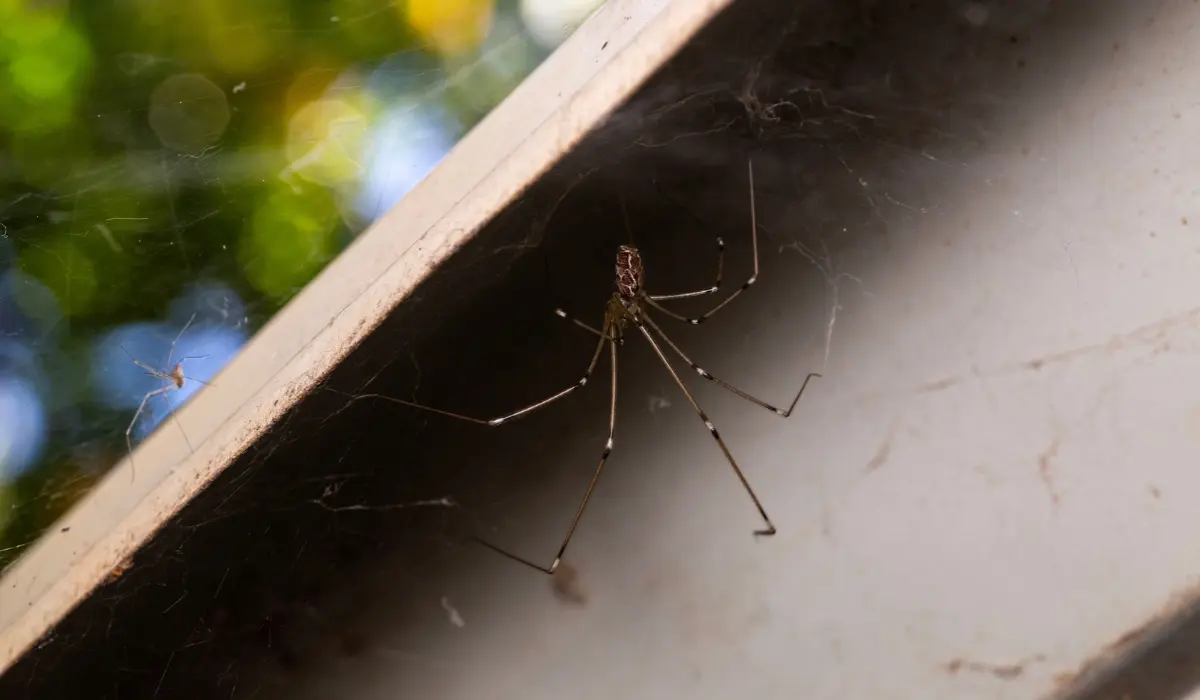
A cellar spider’s proportions are usually the first clue. Its body looks small compared with its very long, narrow legs. You will usually find cellar spiders hanging in loose, irregular webs instead of moving across an open floor.
Common web locations include basement corners, exposed floor joists, pipes, shelving, utility areas, garages, and crawl spaces. These sheltered areas give the spiders stable places to anchor webs where they are less likely to be disturbed.
The University of Kentucky Department of Entomology provides educational information on cellar spiders and other household arthropods. With cellar spiders, body proportions, web style, location, and behavior are more useful together than any single feature.
Why Cellar Spiders Shake in Their Webs
When disturbed, a cellar spider may vibrate rapidly in its web. The movement can make the spider and its long legs appear blurred for a moment.
That behavior is another useful clue when it appears with the spider’s small body, long legs, and loose web. You do not need to touch the spider or web to test it. Observe it from a comfortable distance instead.
Because common spiders in Michigan differ in body shape, web placement, and behavior, long legs alone are not enough to identify a cellar spider.
Cellar Spider vs. Daddy Longlegs
The name “daddy longlegs” causes confusion because people use it for more than one type of arachnid. Cellar spiders and harvestmen can both receive that nickname even though they belong to different groups.
Cellar spiders are true spiders in the family Pholcidae and build webs. Harvestmen belong to the order Opiliones. They are arachnids, but they are not true spiders and do not build the loose capture webs associated with cellar spiders.
| Feature | Cellar Spider | Harvestman |
| True spider | Yes | No |
| Builds capture webs | Yes | No |
| Called daddy longlegs | Often | Often |
| Useful identification clue | Usually found hanging in a loose web | Often seen moving without a capture web |
| General appearance | Small body with very long, thin legs | Long-legged arachnid with a different body structure |
If the animal is hanging in an irregular basement web, a cellar spider is a better fit than a harvestman. The nickname alone cannot tell you which one you found.
Where the Venom Myth Comes In
The daddy longlegs name also feeds one of the most persistent spider myths. Different animals get grouped under the same nickname, then claims about one are repeated as though they apply to all of them.
UC Riverside’s spider research has addressed the daddy longlegs myth and the confusion surrounding the name. Keeping cellar spiders and harvestmen separate removes much of that confusion.
Are Cellar Spiders Dangerous?
The claim that daddy longlegs are among the most venomous spiders but cannot harm people because their fangs are too small is unsupported. It also mixes together animals that are not all spiders.
Cellar spiders are not generally regarded as a major medical concern in homes. If you find one in an accessible basement or garage corner and want it removed, you can vacuum the spider and web without handling it directly.
If the spider does not match the usual cellar spider appearance, do not pick it up to get a closer look. A clear photo taken from a comfortable distance can be more useful for identification.
Why Cellar Spiders Show Up in Basements and Crawl Spaces
Basements, garages, crawl spaces, utility rooms, and storage areas give cellar spiders plenty of protected places to anchor webs. Joists, shelving, pipes, wall corners, and other fixed surfaces allow webbing to remain undisturbed for long periods.
These areas can also support small insects and other arthropods that spiders feed on. When cellar spider webs repeatedly return throughout the same room, the environment is continuing to provide suitable web locations and prey.
That combination helps explain why spiders gather in Michigan basements while the main living areas may have much less visible activity.
What a Lot of Cellar Spiders Can Tell You
One or two cellar spiders in an unfinished basement do not automatically indicate a larger problem. Recurring webs throughout the space are more useful as a prompt to inspect what else is happening there.
First, look for other insects around windows, exterior doors, utility penetrations, foundation openings, light fixtures, and storage areas. A steady supply of small prey gives spiders a reason to stay.
Then check for leaks, condensation, persistently damp materials, or humid sections of a basement or crawl space. Cellar spiders do not prove that a moisture problem exists, but moisture can support conditions that favor other pests. The spiders are a reason to inspect, not a moisture test.
How to Reduce Cellar Spiders in Your Michigan Home
Removing the visible spiders is only one part of the job. If webs return soon after cleaning, focus on the places spiders are building, the insects available for food, and the conditions in that part of the home.
Remove Spiders and Old Webbing
Vacuum accessible cellar spiders and webs from floor joists, wall corners, pipes, shelving, utility areas, and other surfaces. This removes both the spider and its web without requiring direct contact.
After cleaning, watch where fresh webbing appears. If the same corner or ceiling area becomes active again, inspect nearby gaps, windows, pipes, and other places where prey insects may be moving.
Removing old webbing also makes new activity easier to recognize instead of leaving you to sort active webs from dusty ones that have been empty for months.
Correct Actual Moisture Problems
Check plumbing, utility areas, foundation walls, and crawl spaces for leaks, condensation, standing water, or damp materials. If you find a moisture source, correct the cause rather than treating the spider as the problem.
Ventilation or dehumidification may help in persistently humid spaces when appropriate for the structure. The goal is to correct damp conditions that may support broader pest activity.
Cut Down on Pest Entry
Small insects and spiders can enter through worn door seals, damaged screens, openings around windows, gaps around utility lines, and other exterior openings.
Those same routes are common examples of how spiders get inside houses. Repair obvious gaps, maintain screens, and replace worn seals where practical.
You do not need to make the house airtight. Focus on clear maintenance problems that give pests an easy route indoors.
Keep Storage Areas Inspectable
Packed storage can leave wall edges, corners, plumbing, and foundation surfaces difficult to see. It also makes routine web removal harder.
Leave enough access around stored items to check for fresh webbing, moisture, and insect activity. You do not need an empty basement or garage, just enough visibility to notice when conditions change.
If spiders repeatedly appear in one specific storage area, inspect that location before treating the entire room as a single problem.
When Web Removal Is Not Enough
Professional spider control becomes more useful when webs return quickly after cleaning, spiders appear throughout several parts of the home, or you are also seeing a noticeable amount of other insect activity.
The underlying issue may be more than the visible spiders. If other insects are providing a consistent food source, repeatedly vacuuming webs can turn into a cycle without reducing the activity for long.
Crawl spaces, high garage corners, utility areas, and other difficult-to-reach locations can also make inspection and removal harder. In those situations, a professional can identify the spider, inspect where activity is concentrated, and look for conditions that may be supporting it.
Keeping Cellar Spider Activity Under Control
Michigan cellar spiders are recognizable by their small bodies, very long thin legs, loose indoor webs, and rapid vibration when disturbed. They are often called daddy longlegs, but they should not be confused with harvestmen, and the familiar claim that daddy longlegs are exceptionally venomous does not accurately describe them.
When cellar spider webs keep returning, check what is happening around them. Other insects, moisture problems, easy entry points, and undisturbed areas can all contribute to recurring spider activity. Web removal works better when those conditions are addressed at the same time.
If cellar spiders continue appearing throughout your basement, garage, crawl space, or other areas, Pest Pros of Michigan can inspect the affected spaces and identify what is contributing to the problem. To schedule an evaluation for recurring spider activity, contact Pest Pros of Michigan.

 Serving Michigan since 2018
 Pest-free guarantee
 Small, local business