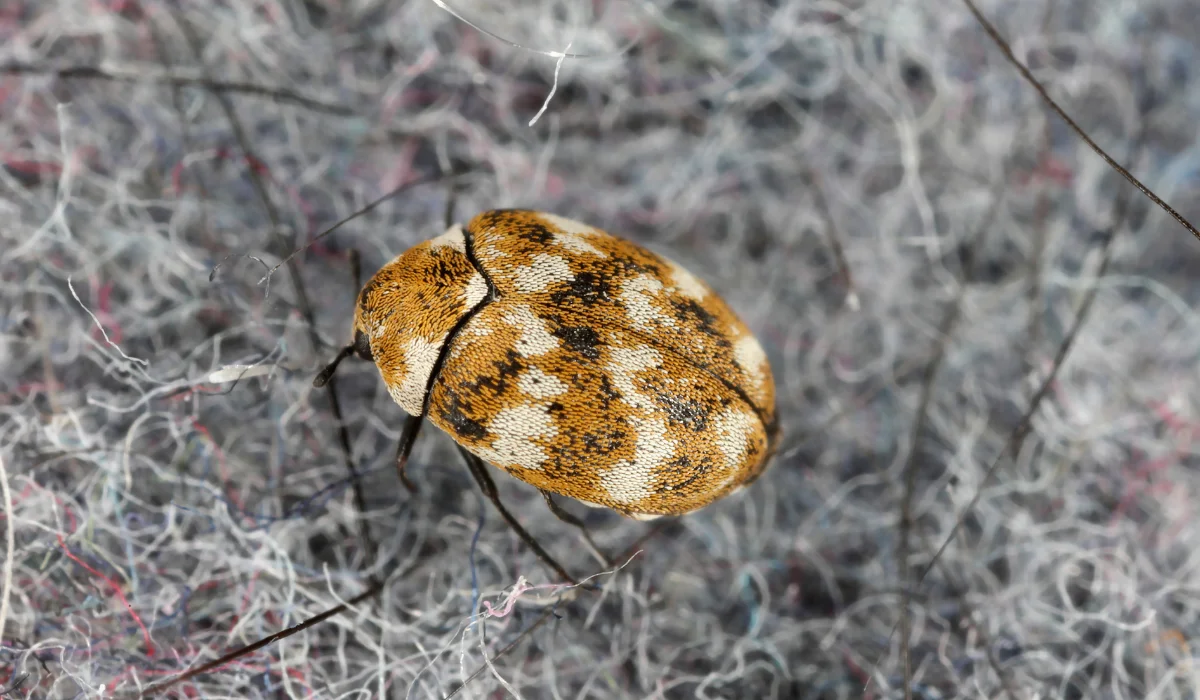
You spot a tiny beetle moving across a windowsill, then find another near a closet or rug a few days later. If you are wondering where do carpet beetles come from, they often start outdoors. Adult carpet beetles can fly inside through windows and doors or arrive on items brought into your home, while their larvae settle in places where they can feed.
The adults you notice are only one part of the problem. To understand a carpet beetle infestation, you need to know how they enter, what attracts carpet beetles indoors, where larvae hide, and which carpet beetle signs point to an active source.
Where Do Carpet Beetles Come From?
Adult carpet beetles commonly live outdoors around flowering plants, where they feed on pollen and nectar. An open window, damaged screen, or small gap around an exterior door can give them an easy route inside.
Once indoors, carpet beetle eggs are usually laid near material the larvae can use as food. The University of California Statewide Integrated Pest Management Program identifies wool, fur, feathers, hair, dead insects, and other animal-based materials as common food sources for carpet beetle larvae.
That helps explain why an adult on the glass may be far from the actual feeding site. Larvae can remain beneath furniture, along carpet edges, inside stored fabrics, or in another quiet area while the adults move toward light.
| Carpet Beetle Stage | Where You May Find It | What It Can Tell You |
| Adult beetle | Windows, walls, doors, flowers | It may have entered from outside or developed indoors |
| Eggs | Hidden near larval food | A feeding site may be nearby |
| Carpet beetle larvae | Closets, carpet edges, furniture, storage areas | Larvae are feeding and developing |
| Shed skins | Baseboards, closets, beneath furniture | Larvae have been active in or near that location |
The carpet beetle life cycle can continue indoors when larvae have a steady food supply. One adult beetle does not prove you have a large infestation, but repeated adults, larvae, shed skins, or damaged material deserve a closer look.
How Carpet Beetles Get Into Michigan Homes
Carpet beetles do not need a large opening in the exterior. Their small size makes ordinary household gaps around windows, doors, and screens enough for an adult to get inside.
Windows and Exterior Doors
If you find carpet beetles on a windowsill, inspect the screen, frame corners, and nearby weather stripping. An adult may have flown inside through a gap, but the window can also be where an indoor beetle is trying to get back outside.
Doors create similar opportunities. Gaps below exterior doors, worn seals, and doors that stay open during warmer Michigan weather give flying insects another route into the house.
Flowers, Stored Items, and Nesting Material
Some carpet beetles arrive on things you carry indoors. Adults can be associated with cut flowers, while larvae or eggs may travel with stored fabrics and belongings moved from an infested location.
Old bird or animal nesting material can also matter. Feathers, hair, and dead insects around an attic, vent, soffit, or wall opening can provide suitable food even after the animal is gone.
| Possible Entry Route | How It Happens | Where to Inspect |
| Window | Adult enters through an opening or damaged screen | Screens, frames, window tracks |
| Exterior door | Adult slips through a poor seal or open doorway | Door sweeps and thresholds |
| Cut flowers | Adult is carried indoors with plant material | Vases and nearby windows |
| Stored belongings | Beetles move with fabrics, boxes, or other items | Closets and storage areas |
| Nesting debris | Larvae gain access to feathers, hair, or insect remains | Attics, soffits, vents |
A clean Michigan home can still develop a carpet beetle problem. What matters most is whether larvae can find a hidden food source after the beetles get inside.
Where Carpet Beetle Larvae Hide and Feed
Carpet beetle larvae prefer protected places where material sits undisturbed. Instead of crawling across an open floor, they are more likely to remain along a wall edge, beneath a rug, behind furniture, or inside a closet.
For homeowners in Michigan, seasonal storage can make those areas easy to overlook. Clothing, blankets, and rugs may stay untouched for months at a time.
Carpet Beetles in Clothes and Natural Fibers
Wool is one of the best-known carpet beetle food sources. Sweaters, blankets, rugs, upholstery, fur, and feather-filled items can all deserve attention when you are tracing carpet beetles in clothes or storage areas. Carpet beetles in closets may remain unnoticed until you pull out a garment that has been stored for a season.
Synthetic carpeting is different because the fiber itself does not provide the same type of food as wool. Still, carpet beetles in carpeted rooms may be feeding on other debris collected along the edges.
Pet Hair, Lint, and Dead Insects
Look under a couch, behind a dresser, or along the edge of a pet bed and you may find more than dust. Pet hair, lint, and insect remains can build up in places that a regular vacuum pass never reaches.
Window tracks, vents, attic corners, and light fixtures can also collect dead insects. These small pockets of material can support larvae even when the room looks clean.
| Possible Larval Food | Places Worth Checking |
| Wool | Rugs, sweaters, blankets, upholstery |
| Fur and feathers | Clothing, bedding, decorative items |
| Pet hair | Beneath furniture, along walls, around pet beds |
| Dead insects | Windows, attics, vents, light fixtures |
| Lint and organic debris | Carpet edges, closets, floor registers |
| Nesting material | Attics, soffits, wall spaces |
Carpet Beetle Signs That Point to an Indoor Infestation
A single adult may have entered yesterday. Repeated activity, especially in one part of the house, gives you more useful information about whether carpet beetles are developing indoors.
Adults Around Windows
Adult carpet beetles often move toward light, so windows are a common place to notice them. If the same room keeps producing adults, inspect the nearby rug, closet, furniture, vents, and stored belongings instead of focusing only on the sill.
A cluster of sightings in one room can help narrow your search. That pattern is more useful than finding isolated beetles in unrelated parts of the house over a long period.
Larvae, Shed Skins, and Carpet Beetle Damage
Carpet beetle larvae look different from adults. They are elongated and covered with visible hairs or bristles, and they can leave shed skins behind in feeding areas.
The Colorado State University Extension explains that irregular damage to wool or other susceptible materials, especially when paired with larvae or shed skins, is stronger evidence of an indoor carpet beetle infestation.
Do not use fabric damage alone to identify the pest. Clothes moths and other insects can affect some of the same materials, so finding larvae or another clear sign gives you a better basis for identification.
How to Get Rid of Carpet Beetles by Finding the Source
If you want to get rid of carpet beetles, start where the evidence is strongest. Killing the adults that happen to cross a wall or window does little if larvae still have access to food behind furniture or inside storage.
Inspect the Areas Normal Cleaning Misses
Move furniture instead of vacuuming around it. Check rug edges and undersides, upholstered furniture seams, closet corners, baseboards, vents, and boxes that contain stored clothing.
If birds or small animals have nested around the roofline, inspect accessible attic areas for old debris. Do not reach into concealed spaces where animals, wiring, or other hazards may be present.
Keep checking nearby items after you find one damaged piece. If one wool blanket has larvae, another blanket stored beside it has been exposed to the same conditions.
Clean and Protect Susceptible Materials
Vacuum accessible larvae, shed skins, pet hair, lint, and insect debris. Attachments can help you reach floor edges, furniture seams, and narrow gaps that ordinary floor cleaning misses.
Clean susceptible clothing according to its care instructions before putting it back into storage. Sealed containers or protective garment storage can reduce access to woolens and other animal-fiber items that will sit unused.
Carpet beetle prevention also includes the exterior. Repair torn screens, replace poor door seals, and close obvious gaps around windows so fewer adult beetles can enter from outside.
When to Call Pest Pros of Michigan for Carpet Beetle Control
You can often reduce carpet beetle activity by removing accessible food sources, vacuuming hidden areas, and protecting susceptible fabrics. Professional carpet beetle control becomes more useful when larvae keep appearing, adults return after cleaning, damage continues, or you cannot locate the source.
A detailed inspection can help trace activity to places you may not normally open or move, including furniture, stored textiles, carpet edges, attic debris, and other protected areas. Pest Pros of Michigan provides inspection, identification, sanitation, targeted treatment, storage measures, and exclusion as part of its fabric and beetle control services.
If carpet beetles keep showing up in your Kalamazoo, Grand Rapids, or West Michigan home, contact Pest Pros of Michigan for an evaluation. Finding the larval feeding source gives you a much better chance of stopping the infestation than dealing with each adult beetle as it appears.

 Serving Michigan since 2018
 Pest-free guarantee
 Small, local business