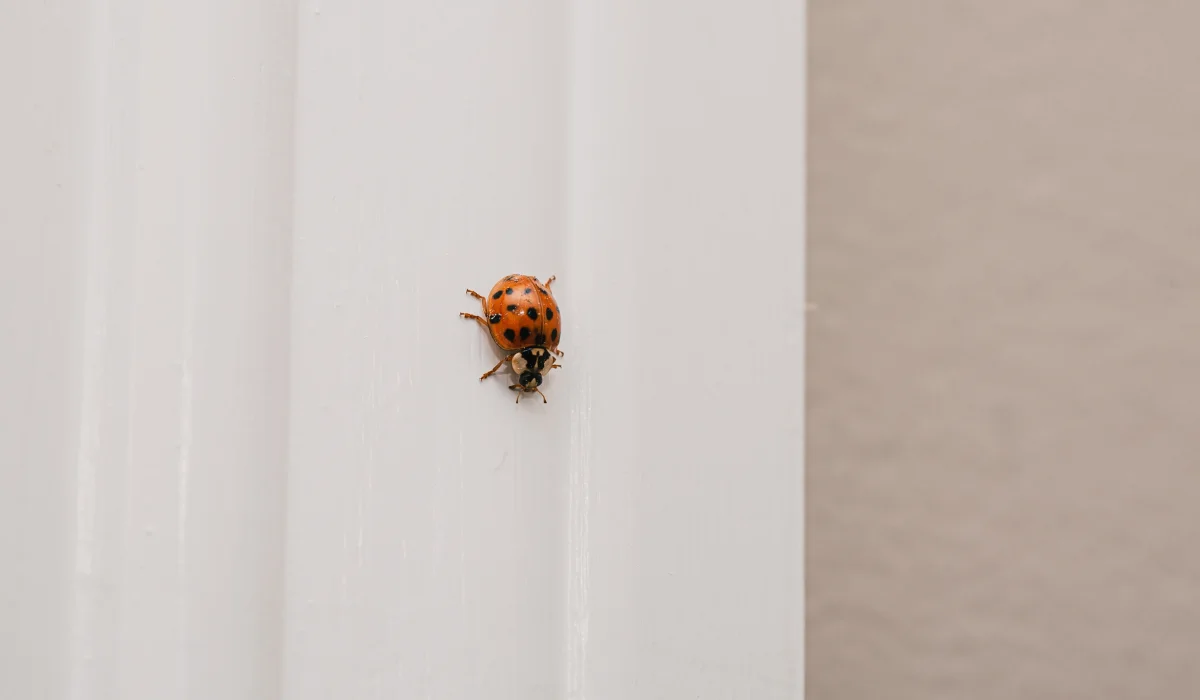
When orange and red beetles cover your siding, windows, or garage door on a warm fall afternoon, it can look like your home has attracted a giant group of ladybugs. In many West Michigan neighborhoods, those insects are more likely Asian lady beetles searching for a protected place to spend the winter.
Asian lady beetles are true members of the lady beetle family, so “imposter” is a homeowner-friendly description rather than a scientific one. They are a nonnative species with habits that differ from the familiar native lady beetles you may see in gardens. Their tendency to gather by the hundreds in homes is one of the clearest differences.
The beetles are not building a nest on your siding, and they generally do not reproduce inside houses. The real concern is that they can squeeze through small exterior openings, settle inside wall spaces or attics, and reappear in living areas throughout winter.
The “Ladybugs” on Your Siding Are Likely Asian Lady Beetles
The multicolored Asian lady beetle, known scientifically as Harmonia axyridis, is a small, rounded beetle that may appear yellow, orange, red, or nearly black. Adults are generally about one-quarter inch long. Their wing covers may have no spots or as many as 19, which makes spot counting an unreliable way to identify them.
A more useful clue is the pale section directly behind the beetle’s head. Many Asian lady beetles have a dark marking in this area that resembles the letter M or W. The marking can vary, so it should be used with other clues rather than treated as a guarantee.
Behavior often provides the strongest evidence. According to the Michigan State University guide to multicolored Asian lady beetles, these beetles commonly gather on buildings while looking for winter shelter. A large ladybug swarm on sunny siding, window frames, rooflines, or trim is often more revealing than color alone.
Why Color and Spot Count Can Be Misleading
Many people picture a ladybug as bright red with a fixed number of black spots. Lady beetles actually include many species with different sizes, colors, and markings. An orange beetle is not automatically an Asian lady beetle, and a red beetle is not automatically a native species.
Season and location help narrow the answer. A few beetles feeding in a garden may belong to any of several beneficial species. Hundreds gathering on a sunlit Michigan home in fall are much more likely to be Asian lady beetles preparing to overwinter.
Asian Lady Beetle vs. Ladybug: How to Tell the Difference
The phrase Asian lady beetle vs. ladybug can be confusing because Asian lady beetles are technically ladybugs. “Ladybug” is a common name applied to many members of the lady beetle family, not one specific insect.
For homeowners, the biggest difference is behavior. Asian lady beetles frequently gather on buildings and enter structures for winter shelter. Other familiar lady beetles may stay outdoors in gardens and landscapes without creating the same large seasonal invasion around siding, windows, and attics.
The comparison below highlights the features that are most useful when you are looking at beetles in your home.
| Feature | Asian Lady Beetle | Other Familiar Lady Beetles |
|---|---|---|
| Color | Yellow, orange, red, or nearly black | Varies by species |
| Spots | Zero to 19 | Often more consistent within a species |
| Marking Behind the Head | Often a dark M- or W-shaped mark | Different markings depending on species |
| Fall Behavior | Frequently gathers on buildings | Less likely to invade structures in large groups |
| Indoor Activity | Common overwintering nuisance | Usually less common indoors |
No single feature confirms the species. The most reliable identification comes from combining the beetle’s markings with the time of year, the location, and the size of the gathering.
Why Asian Lady Beetles Swarm Michigan Siding in Fall
Asian lady beetles in Michigan become especially noticeable when adults begin searching for sheltered winter sites. Sun-warmed exterior walls can attract large groups, particularly when nearby cracks, seams, or gaps lead into protected parts of the structure.
The cluster on your siding is not a colony or a nest. It is an aggregation of adult beetles responding to seasonal conditions. Once they locate an opening, they may move into attics, wall voids, garages, or spaces around window and door frames.
Common access points include worn weather stripping, gaps around pipes and wiring, loose siding edges, damaged screens, attic vents, soffits, fascia boards, and openings around roof trim. Because the beetles can travel inside wall spaces, the room where you later find them may not be close to the original entry point.
Why They Reappear During Winter
Asian lady beetles usually remain inactive while sheltered inside a structure. Indoor heat or a mild winter day can wake them, causing them to move toward windows, light fixtures, and other bright areas.
This activity does not usually mean they are breeding in your home. The beetles are trying to leave their winter shelter, but indoor light may draw them deeper into the living space instead of guiding them outdoors.
Do Asian Lady Beetles Bite or Damage Your Home?
Asian lady beetles do not feed on blood, but they can occasionally pinch or scrape exposed skin. People often call this an Asian lady beetle bite, although it is not the same feeding behavior associated with mosquitoes, fleas, or bed bugs.
The beetles may also release a yellow-orange defensive fluid from their leg joints when disturbed or crushed. This response is called reflex bleeding. The fluid has an odor and can leave marks on walls, curtains, upholstery, and other light-colored surfaces.
The University of Minnesota guidance on multicolored Asian lady beetles describes them primarily as a nuisance inside buildings. They do not eat structural wood, insulation, clothing, or stored food.
Even without structural damage, an Asian lady beetle infestation can become frustrating. Beetles may repeatedly appear near windows, ceilings, upper rooms, and light fixtures throughout winter. Cleanup also becomes harder when large numbers collect on finished indoor surfaces.
How to Get Rid of Asian Lady Beetles Without Staining Your Walls
When you find Asian lady beetles in the house, use a vacuum rather than crushing them. Vacuuming removes visible beetles quickly while reducing the risk of defensive fluid staining paint, fabric, or trim.
Empty the vacuum outdoors soon after collection, or seal and discard the contents. Beetles left inside a bag or canister may survive and crawl back into the home.
Avoid sweeping large groups into piles or pressing them against windows and walls. Even light handling may cause some beetles to release their defensive fluid. A vacuum hose allows you to collect them with less direct contact and less mess.
Why Indoor Removal Is Only Part of the Solution
Vacuuming handles the beetles you can see, but it does not close the openings they used to enter. It also cannot reach every beetle resting inside an attic, wall void, or other concealed space.
Repeated winter sightings often point to exterior gaps that need attention before the next fall movement. Indoor cleanup is useful for immediate relief, but long-term control depends on keeping the next group from getting inside.
How to Prevent Asian Lady Beetles From Entering Your Michigan Home
The best time to address a lady beetle infestation is before large groups settle into the structure. Late summer gives you an opportunity to inspect siding, trim, screens, vents, and weather stripping before fall activity increases.
Seal gaps around windows, doors, pipes, wiring, and utility lines. Repair damaged screens, secure loose siding, and inspect soffits, fascia boards, roof intersections, and attic openings. Pay close attention to the areas where beetles gathered in previous years because those locations may contain easy entry points.
The University of Kentucky fact sheet on Asian lady beetle infestations identifies structural exclusion as a central part of prevention. Once beetles are inside wall spaces, stopping every indoor appearance becomes much more difficult.
Professional service may be helpful when beetles return in large numbers each year, gather around upper stories, or enter through areas that are difficult to inspect safely. An exterior evaluation can identify likely access points and help determine where preventive service will have the most value.
Keeping Asian Lady Beetles Outside Your West Michigan Home
That orange ladybug swarm on your siding is usually a group of Asian lady beetles looking for winter shelter, not a nest or an indoor breeding population. Their variable colors and spots can make identification difficult, but the pale marking behind the head and their fall gathering behavior provide useful clues.
Vacuum visible beetles instead of crushing them, then focus on the exterior openings that allowed them inside. Repairing screens, weather stripping, siding seams, vents, and utility gaps can reduce the chance of another seasonal invasion.
When Asian lady beetles return year after year in Kalamazoo, Grand Rapids, or nearby communities, Pest Pros of Michigan can inspect your home and recommend a practical plan for keeping seasonal pests outside. To schedule an evaluation, contact the Pest Pros team before the next fall gathering begins.

 Serving Michigan since 2018
 Pest-free guarantee
 Small, local business