Cockroaches in Michigan fall into two groups: the German cockroach, which lives and breeds entirely indoors, and peridomestic species like the American, Oriental, and wood roach, which mostly live outside and wander in. Which one you’re dealing with determines how serious the situation is and what kind of response actually works.
Key Takeaways
- The German cockroach is small, tan, with two dark stripes on its back, and breeds exclusively indoors. Seeing one during the day means the population is already large.
- American, Oriental, and wood roaches live outdoors. Finding one near a basement drain or exterior door is often incidental, not a sign of an established indoor colony.
- Droppings, egg cases, and odor are the first signs of an active infestation and typically appear before large numbers of live cockroaches are seen.
How to Identify an Active Infestation by the Signs Left Behind
Cockroaches are rarely seen in large numbers before the infestation is well established. The signs they leave behind are usually the first reliable indicators and tell you both where the population is concentrated and how long it has been active.
What Cockroach Droppings Look Like and Where to Find Them
German cockroach droppings resemble black pepper or coffee grounds and are typically found in areas where the population is concentrated: the corners of cabinet shelves, the inside edges of appliance gaps, along baseboards in kitchens and bathrooms. American and Oriental cockroach droppings are larger, cylindrical, and have ridges along the sides. The volume and location of droppings gives a reasonable indicator of where the population is centered.
Egg Cases Confirm Reproduction Has Already Happened
Cockroach egg cases, called oothecae, are dark brown, capsule-shaped structures roughly a quarter inch long. German cockroaches carry the ootheca attached to their body until shortly before hatching, then deposit it in a protected harborage area. Finding oothecae, whether empty, intact, or partially hatched, in cabinet corners, appliance gaps, or under sinks confirms that reproduction has already occurred in that location.
Odor Points to Where the Population Is Concentrated
A significant German cockroach infestation produces a musty, oily odor that becomes noticeable before the insects themselves are visible in large numbers. The odor comes from aggregation pheromones the insects produce and is particularly detectable in enclosed spaces like under-sink cabinets and inside appliance gaps. If a kitchen or bathroom smells off in a way that doesn’t trace to an obvious source, cockroach activity is worth investigating.
The Species You Are Most Likely to Find in a Michigan Home
Michigan’s cockroaches, sorted by what they mean
Not every cockroach sighting means the same thing. German cockroaches breed entirely indoors and mean an established population, while American, Oriental, and wood roaches are outdoor species that wander in. Here is how to tell them apart and how much each one calls for action.
German Cockroach
Indoor breederTan to light brown, about half an inch long, with two dark parallel stripes running lengthwise behind the head.
Where Kitchens and bathrooms, concentrated behind appliances, under sinks, and inside cabinet hinges.
American Cockroach
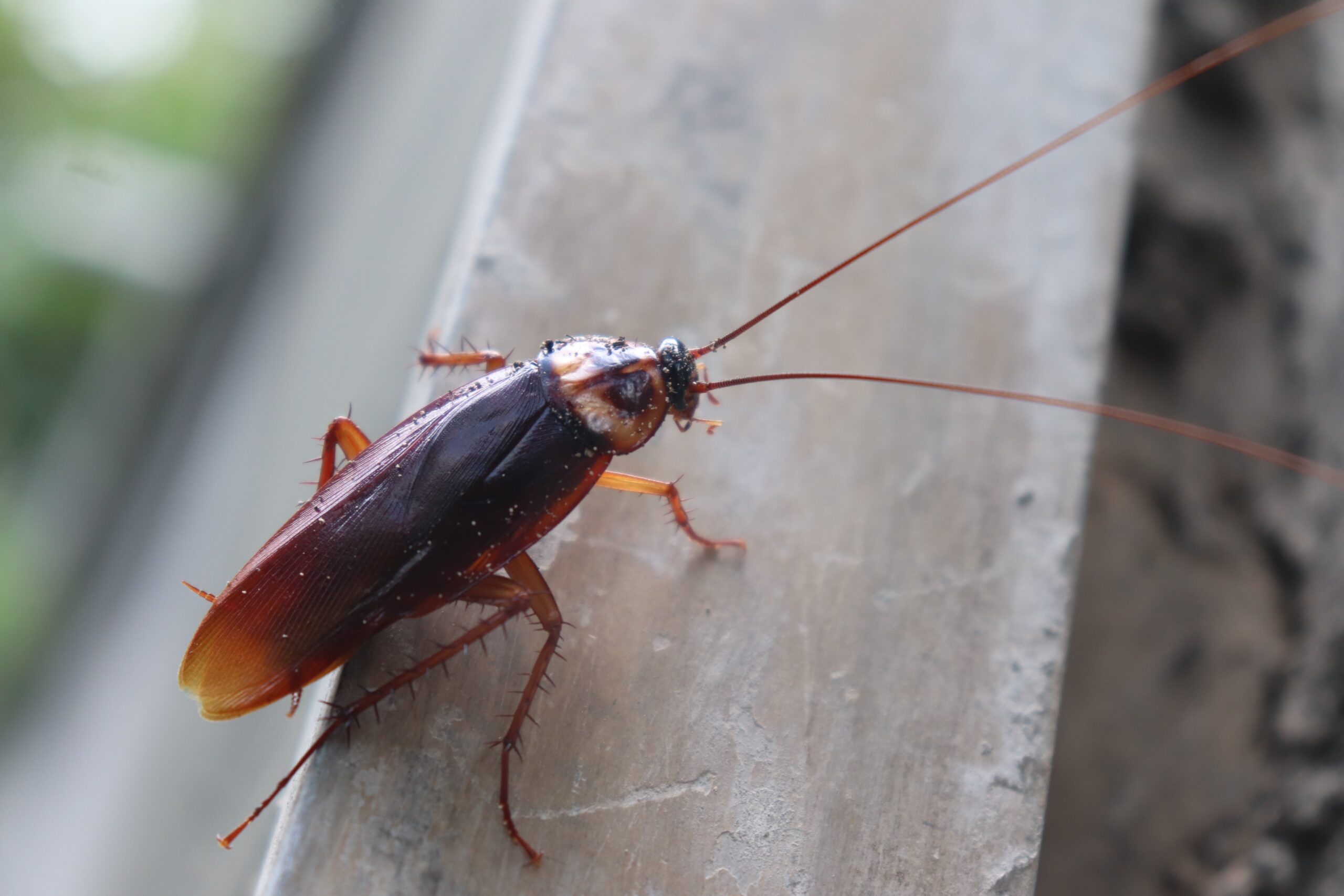
Basement invaderReddish-brown and up to two inches long, with a yellowish figure-eight marking on the back of the head.
Where Basements, crawl spaces, floor drains, and utility areas; can travel through sewer systems.
Oriental Cockroach
Moisture-drivenDark brown to nearly black, about an inch long; males have short non-functional wings, females are wingless.
Where Basements, crawl spaces, and areas around floor drains or sump pumps.
Wood Roach
Mistaken IDSimilar in size and color to the German cockroach, but moves toward light instead of away from it.
Where Under bark, wood piles, and leaf litter outdoors; occasionally hitchhikes in on firewood.
Michigan has four cockroach species that regularly turn up in homes and businesses. Two live and breed entirely indoors; two are outdoor insects that enter structures when conditions push them inside. Which category a sighting falls into determines both how urgent the response needs to be and what kind of treatment actually works.
German Cockroach: The Indoor Breeder
The German cockroach is the species most pest control professionals encounter in Michigan residential work. Adults are about half an inch long, tan to light brown, with two dark parallel stripes running lengthwise behind the head. Nymphs are smaller and darker but carry the same stripe pattern. This species lives, feeds, and reproduces entirely inside a structure, preferring warm and humid areas close to food and water. Kitchens and bathrooms are the most common locations, with populations concentrating behind appliances, under sinks, inside cabinet hinges, and along the edges of counters near food prep areas.
German cockroaches reproduce quickly. A single female can produce multiple egg cases in her lifetime, each containing up to 40 eggs. Because they are negatively phototrophic, meaning they actively avoid light, the infestation is usually well established by the time live cockroaches are seen during the day. Daytime sightings are a sign that harborage areas are overcrowded, not that the problem is new.
American Cockroach: Large, Outdoor-Origin, Basement-Dwelling
The American cockroach is the largest cockroach species commonly found in Michigan homes, reaching up to two inches in length. It is reddish-brown with a distinctive yellowish figure-eight marking on the back of its head. Despite its size, it is a peridomestic species, primarily an outdoor insect that enters structures in search of warmth or moisture rather than establishing permanent indoor colonies. In Michigan homes, American cockroaches are most commonly found in basements, crawl spaces, floor drains, and utility areas. They can travel through sewer systems and enter through drain pipes, which is one reason they appear in basements and bathrooms even when no exterior entry point is obvious.
Finding one or two American cockroaches near a drain or in a basement is worth investigating but is not the same situation as a German cockroach infestation. The presence of egg cases or multiple size classes of the same species in the same area would indicate a more established problem.
Oriental Cockroach: The Damp Basement Species
The Oriental cockroach is dark brown to nearly black and about an inch long. Males have short, non-functional wings; females are wingless. This species is sometimes called the “water bug” because of its strong preference for cool, damp environments. In Michigan homes, Oriental cockroaches are most commonly found in basements, crawl spaces, and areas around floor drains or sump pumps. They move more slowly than German cockroaches and tend to cluster in predictable, moisture-heavy locations rather than spreading through a structure.
Oriental cockroaches can enter through gaps in the foundation, floor drains, and utility penetrations. Like the American cockroach, they are not true indoor breeders in the way German cockroaches are, but a persistent moisture problem can support an ongoing Oriental cockroach presence that outlasts basic pest treatments if the moisture source is not addressed.
Wood Roach: Outdoor Species, Incidental Visitor
The wood roach looks similar to the German cockroach in size and color but behaves entirely differently. It is an outdoor species native to Michigan that lives under bark, in wood piles, and in leaf litter. Wood roaches occasionally enter homes by accident, typically hitchhiking on firewood or through gaps near wooded areas. They do not establish indoor populations and cannot survive long-term inside a home without the decaying organic matter they feed on outdoors.
A wood roach found inside is almost always an incidental entry that does not require the same response as a German cockroach. The key difference is behavior: wood roaches are attracted to light and will move toward windows and exterior walls, while German cockroaches avoid light and retreat toward dark harborage areas.
Why Michigan Homes Are Vulnerable
Michigan’s climate creates specific conditions that contribute to cockroach pressure, particularly in urban areas and multi-unit housing. Three factors stand out: cold winters that push outdoor species indoors, older housing stock with more structural gaps, and dense multi-unit rental buildings where German cockroaches can spread between units.
Winter Drives Peridomestic Species Indoors
Cold Michigan winters push American and Oriental cockroaches out of their outdoor habitats and toward any structure offering warmth. Basement gaps, floor drains, and utility penetrations that are tolerable access points in summer become active entry routes as temperatures drop. This is why American and Oriental cockroach sightings in Michigan homes tend to increase in fall and early winter.
Older Housing Stock Creates More Entry Points
West Michigan’s mix of older residential and commercial buildings, particularly in Kalamazoo, Grand Rapids, and Battle Creek, has more deteriorated seals around pipes, aging floor drains, and settling foundations than newer construction. These structural conditions create the gaps and moisture accumulation that both peridomestic species and German cockroaches exploit. A German cockroach introduced to a building with these conditions has more harborage and less competition than it would in a tightly constructed newer structure.
Multi-Unit Housing Allows German Cockroaches to Spread
German cockroaches move between units through shared wall voids, plumbing chases, and electrical conduits. A single infested unit in an apartment building or multi-family property is enough to seed neighboring units within weeks. Michigan’s urban rental stock, with its higher concentration of older multi-unit buildings, is one of the environments where German cockroach infestations are most difficult to fully resolve without treating adjacent units simultaneously.
When to Call Pest Pros of Michigan
Call us when you are seeing cockroach activity repeatedly in the same area, finding droppings or egg cases in cabinet corners or under appliances, or noticing activity during daylight hours. Daytime sightings in particular suggest the harborage is crowded, meaning the visible insects represent a fraction of the actual population.
Professional service makes sense when:
- You have seen live cockroaches, especially during the day.
- You are finding droppings in kitchen or bathroom cabinets, behind appliances, or under sinks.
- You have found egg cases, which confirm reproduction has already occurred indoors.
- You are noticing a musty or oily odor in the kitchen or bathroom with no clear source.
- Treatment attempts have reduced activity temporarily but the problem keeps returning.
- You live in a multi-unit building and have found cockroaches in more than one room.
- You want to confirm the species before deciding on a treatment approach.
Pest Pros of Michigan provides cockroach control services for homes and businesses across Michigan, with a treatment approach that varies by species because German cockroach infestations require a fundamentally different protocol than peridomestic species entering from outside.
Schedule a Cockroach Inspection in Michigan
If you are seeing cockroach activity or finding the signs of an infestation, we can inspect the areas where roaches are most likely to be concentrated, identify the species, and recommend a treatment plan that addresses both the visible population and the harborage conditions supporting it.
Contact Pest Pros of Michigan to request cockroach control in your area.
Frequently Asked Questions
How do I know if I have German cockroaches or a different species?
Size and location are the fastest clues. German cockroaches are small, about half an inch, tan with two dark stripes, and found in kitchens and bathrooms near food and moisture. American cockroaches are much larger, reddish-brown, and most commonly found near basement drains. Wood roaches look similar to German cockroaches but move toward light rather than away from it, and they are typically found near exterior walls or windows after coming in on firewood.
Is one cockroach a sign of an infestation?
It depends on the species. A single American, Oriental, or wood roach near a door or drain is often incidental and may not indicate a larger problem. A single German cockroach in a kitchen is more significant because German cockroaches do not wander in from outside. They live and breed indoors, so their presence suggests an established population is already present somewhere in the structure.
Why do I keep seeing cockroaches even after cleaning thoroughly?
German cockroach populations concentrate in harborage areas that routine cleaning does not reach: inside appliance gaps, behind refrigerator compressor areas, inside wall voids near plumbing, and along the underside edges of cabinetry. Sanitation reduces food sources and helps, but it does not eliminate the harborage where the population is actually living and reproducing. Professional treatment targets those specific areas.
Can cockroaches spread between apartments in a Michigan building?
Yes. German cockroaches in particular move readily between units through shared plumbing chases, wall voids, and electrical conduits. A single infested unit can seed neighboring units relatively quickly. Effective control in multi-unit housing typically requires inspecting and treating adjacent units, not just the unit where cockroaches were first reported.

 Serving Michigan since 2018
 Pest-free guarantee
 Small, local business
 10+ years of pest control experience
 President and CEO of Pest Pros of Michigan
 Resident of Michigan