Most centipedes found in Michigan homes are house centipedes, and their presence almost always signals two things: moisture and prey insects. The house centipede is the only Michigan centipede capable of reproducing indoors, according to MSU Extension. Stone and bark centipedes wander in from the yard but cannot maintain indoor populations. Which species you have determines whether you have an underlying structural condition to address or a one-time accidental entry.
Key Takeaways
- The house centipede is the only Michigan centipede that reproduces indoors. Finding more than one or two regularly means conditions inside the structure are supporting them.
- House centipedes in a Michigan home indicate moisture and prey insects. They feed on spiders, silverfish, cockroaches, and other small arthropods.
- Stone and bark centipedes enter homes accidentally and cannot establish indoor populations. A single sighting near a door or basement window is usually incidental.
Michigan Centipede Species at a Glance
Michigan centipedes, sorted by what to do
Only one Michigan centipede can actually establish itself indoors. The other two just wander in from the yard. Here is how to tell them apart and how much each one calls for action.
House Centipede
Indoor breederYellowish-gray with three dark dorsal stripes and 15 pairs of very long, banded legs; extremely fast and can scale walls.
Where Damp basements, crawl spaces, and bathrooms, along baseboards and under appliances.
Stone/Bark Centipede
Accidental entryReddish-brown to dark brown, roughly the same length as the house centipede, but with considerably shorter legs and no long trailing antennae or cerci; movement is slower and more deliberate.
Where Under stones, boards, bark, leaf litter, and mulch near the foundation.
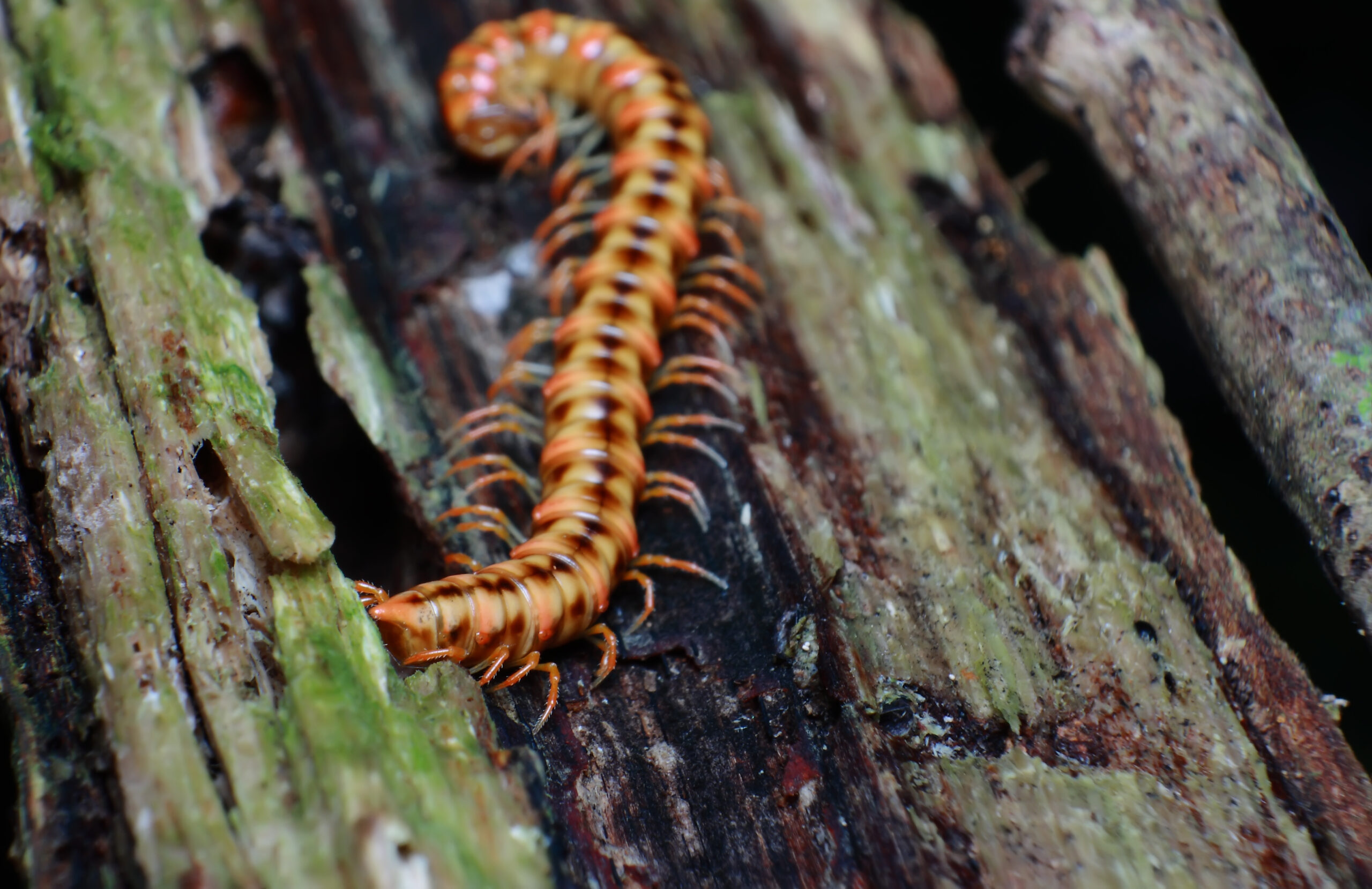
Eastern Red Centipede
Outdoor onlyReddish-orange with prominent large fangs.
Where Under bark, stones, and leaf litter outdoors.
| Species | Size | Color | Key Feature | Found Indoors? |
|---|---|---|---|---|
| House Centipede | 1 to 1.5 inches | Yellowish-gray with three dark dorsal stripes | 15 pairs of very long banded legs; extremely fast | Yes — only species that reproduces indoors |
| Stone/Bark Centipede | 1 to 1.5 inches | Reddish-brown to dark brown | Shorter legs than house centipede; flattened body | Occasionally — accidental entry, cannot establish indoors |
| Eastern Red Centipede | 1 to 2 inches | Reddish-orange | Prominent large fangs; found under bark, stones, leaf litter | Rarely — strictly an outdoor species |
The House Centipede: What It Is and What Its Presence Means
The house centipede is what most Michigan residents encounter when they find a centipede indoors, and its presence tells you more about the condition of the structure than it does about the centipede itself. MSU Extension classifies it as the only Michigan centipede that can reproduce indoors, which means repeated sightings are a signal worth investigating rather than ignoring.
How to Identify a House Centipede
The house centipede (Scutigera coleoptrata) has a yellowish-gray body marked with three dark stripes running lengthwise along its back. Adults are 1 to 1.5 inches long with 15 pairs of legs that are notably longer than the body itself. The legs are banded with alternating light and dark segments. Its antennae and rear cerci are also very long, giving it a larger apparent size than its body length suggests. It moves in quick darting bursts and can scale walls and ceilings, which is why it tends to startle people.
Why House Centipedes Appear Indoors
House centipedes follow prey and moisture. They feed on spiders, silverfish, cockroaches, ants, and other small arthropods. A home with house centipedes almost always has both a moisture problem and an established prey insect population supporting them. MSU Extension is direct on this point: if house centipedes are abundant, other insects are present for them to feed on. The centipede is the visible indicator of a less visible underlying condition.
They prefer damp basements, crawl spaces, and bathrooms, and are most commonly found along baseboards, under appliances, and in the corners of unfinished basement spaces. They are nocturnal and avoid light, which is why most sightings happen at night or when a dark storage area is disturbed.
Stone and Bark Centipedes: Outdoor Species That Wander In
Stone and bark centipedes (Lithobius spp.) are common in Michigan’s gardens, lawns, and wooded areas, but they do not establish indoor populations the way house centipedes do. A stone centipede found inside tells you an entry point exists, not that the structure has a centipede problem.
How Stone Centipedes Differ From House Centipedes
Stone centipedes are reddish-brown to dark brown, roughly the same length as house centipedes, but their legs are considerably shorter and they lack the long trailing antennae and cerci of the house centipede. Their movement is slower and more deliberate. They are most commonly found under stones, boards, bark, leaf litter, and mulch near the foundation rather than inside the living space.
What a Stone Centipede Sighting Means
A single stone centipede near a basement window, door threshold, or foundation gap is usually an accidental entry rather than a sign of an indoor population. They cannot maintain themselves indoors over time. If stone centipedes are found repeatedly near entry points, the more useful question is why those entry points are open, not how to treat the centipede itself.
What House Centipedes in Your Basement Actually Indicate
A house centipede found in a Michigan basement is almost never just a nuisance pest. Two conditions have to exist simultaneously for house centipedes to establish and reproduce indoors: enough moisture to make the environment hospitable, and enough prey insects to sustain the population.
Persistent moisture in a Michigan basement can come from foundation seepage, condensation on cold surfaces, plumbing leaks, inadequate ventilation, or soil moisture migration through block or poured walls. MSU Extension notes that homes with damp basements or crawl spaces are the preferred environment for house centipedes. Reducing that moisture disrupts the habitat rather than just removing the visible pest.
The prey insect question is equally important. A house centipede population feeding on silverfish, spiders, or cockroaches in the basement indicates that those species are present at a level sufficient to support a predator. Treating for centipedes without addressing the prey population produces short-term results only.
How to Reduce House Centipede Activity in a Michigan Home
Reducing house centipede pressure requires working on both the moisture side and the prey insect side simultaneously. Removing visible centipedes without addressing either condition typically results in the same population re-establishing within a season, because the habitat that attracted them hasn’t changed.
On the moisture side: run a dehumidifier in any below-grade space that stays damp through summer, repair any active plumbing leaks, improve drainage away from the foundation, and check that basement windows and crawl space vents are functioning and not blocked. Leaf litter and wood debris stacked against the foundation hold moisture and provide harborage for both centipedes and their prey.
On the pest side: sealing entry points along the foundation perimeter, particularly around pipe penetrations, window frames, and utility entries, reduces the flow of prey insects that centipedes are following indoors. A foundation perimeter barrier treatment applied by a pest professional in late summer targets both prey insects and centipedes before fall entry activity peaks.
When Michigan Centipedes Are Most Active
House centipede activity in Michigan peaks in late summer when prey insect populations are at their highest, and outdoor species enter structures most aggressively in fall as temperatures drop. The fall entry window is the one most homeowners miss, and it’s where timing a perimeter treatment makes the biggest difference.
Spring Through Fall: Peak Activity Above Ground
House centipedes are active throughout the warmer months, hunting prey insects that are also more active from spring through fall. In Michigan, this means peak activity roughly from April through October. They may be seen at any time of year indoors if the structure provides consistent warmth and moisture, but encounters increase in late summer as prey insects reach peak populations.
Fall Entry and Overwintering
Stone centipedes and other outdoor species are most likely to enter structures in fall as temperatures drop and they seek protected overwintering sites. This is the same seasonal pattern that brings millipedes, earwigs, and stink bugs into Michigan homes. House centipedes, already established indoors, become more visible in fall and winter when other insect activity slows and they move into warmer interior spaces. Foundation-perimeter treatments applied in late summer or early fall, before this movement begins, are more effective than treatments applied after entry has already occurred.
When to Call Pest Pros of Michigan
Call us when house centipedes are appearing regularly in the same areas of the home, when the sightings are increasing over multiple seasons, or when you want both the centipede activity and the underlying moisture and prey insect conditions assessed at the same time. A centipede treatment applied without addressing what’s supporting them produces temporary results.
Professional service makes sense when:
- You are seeing house centipedes regularly in the basement, bathroom, or other damp areas.
- Centipede sightings have increased over the past season or two.
- You have already tried reducing moisture but the activity continues.
- You want a foundation perimeter treatment applied before fall entry season.
- You want the prey insect population assessed alongside the centipede activity.
- You are finding centipedes in living areas above the basement level.
Pest Pros of Michigan provides centipede control services for homes and businesses across Michigan, addressing both the centipede activity and the moisture and pest conditions that support it.
Schedule a Centipede Inspection in Michigan
If you are seeing house centipedes regularly and want to know what conditions are supporting them, we can inspect the property, assess moisture levels and prey insect activity, and recommend a treatment approach that addresses the source rather than just the symptom.
Contact Pest Pros of Michigan to request a centipede inspection.
Frequently Asked Questions
Is the house centipede the only centipede that lives in Michigan homes?
Yes. MSU Extension confirms the house centipede is the only Michigan centipede capable of reproducing indoors. Other species, including stone centipedes and the eastern red centipede, may enter accidentally but cannot maintain indoor populations.
Are centipedes in Michigan dangerous?
House centipedes can bite if handled or stepped on, and the bite can be as painful as a bee sting, but they are not considered medically significant. MSU Extension notes that biting is uncommon and occurs primarily when the animal is directly threatened. They do not damage structures, food, or fabric.
What does it mean if I keep seeing centipedes in my basement?
Repeated house centipede sightings in a Michigan basement indicate two conditions are present: enough moisture to make the space hospitable and enough prey insects to support a population. House centipedes feed on spiders, silverfish, cockroaches, and other small arthropods. Addressing the moisture and the prey insect population is more effective than treating the centipede alone.
When are centipedes most likely to enter Michigan homes?
Outdoor centipede species enter most frequently in fall as temperatures drop and they seek protected overwintering sites. House centipedes are active year-round indoors but become more visible in fall and winter when prey insect activity slows and they move into warmer areas of the structure. Foundation perimeter treatments are most effective when applied in late summer before this seasonal movement begins.

 Serving Michigan since 2018
 Pest-free guarantee
 Small, local business
 10+ years of pest control experience
 President and CEO of Pest Pros of Michigan
 Resident of Michigan