Carpenter ants are a common wood-damaging ant in Michigan, but they do not eat wood the way termites do. They excavate galleries for nesting, often in wood affected by moisture. For carpenter ants Michigan homeowners find indoors, the key questions are whether the ants are nesting in the structure, where the colony is located, and whether moisture is helping support the problem. Frass, recurring trails, indoor swarmers, and activity around damp wood can provide useful clues.
Carpenter Ants Vs. Termites: Start With the Difference
Carpenter ants and termites can both turn up around damaged wood, but they use wood differently. Carpenter ants remove material to make nesting galleries. Termites consume cellulose as food. That difference affects both the damage and the signs you are likely to find.
Carpenter ant galleries tend to be relatively clean because workers carry excavated material out of the nest. Eastern subterranean termites live in the soil and build mud tubes that help them travel to wood above ground. The body shape also differs. Carpenter ants have a pinched waist and elbowed antennae, while termites in Michigan have broader bodies and straighter antennae.
| Feature | Carpenter Ants | Eastern Subterranean Termites |
| Relationship with wood | Excavate it for nesting | Consume cellulose |
| Waist | Narrow and pinched | Broad |
| Antennae | Elbowed | Straighter and beadlike |
| Swarmer wings | Front pair longer than rear pair | Front and rear pairs similar in length |
| Galleries | Relatively clean and smooth | May contain soil or muddy material |
| Common clue | Excavated debris or frass | Mud tubes |
Wood debris alone does not identify either pest. The insect itself, the condition of the wood, and the surrounding evidence should all be considered before deciding what is causing the damage.
How to Identify Carpenter Ants in Michigan
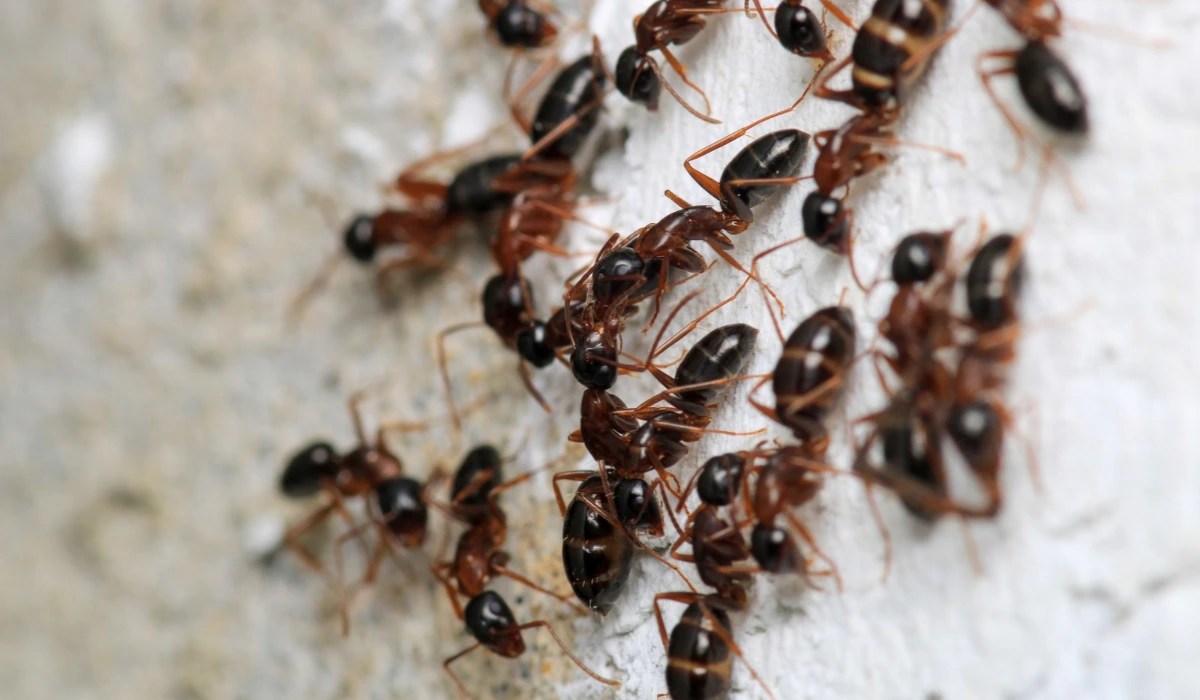
Carpenter ants are large compared with many household ants, although workers from the same colony can vary in size. Many are black, while some species show reddish-brown and black coloring. Because color varies, body structure is more useful for identification.
Look for elbowed antennae, a narrow waist, and a smoothly rounded upper thorax when viewed from the side. The University of Minnesota Extension’s carpenter ant information describes these features and the size variation found among workers. Michigan homes can also host several common ant species, so size and color should be considered along with behavior and nesting clues.
A single large ant indoors does not prove there is a nest in the house. Repeated workers using the same window frame, wall opening, plumbing area, or foundation edge are more useful because they reveal an established travel route.
How Carpenter Ant Swarmers Differ From Workers
Winged carpenter ants are reproductive adults, commonly called swarmers or alates. Their appearance can cause confusion with termite swarmers because both may show up around windows or lights.
Carpenter ant swarmers retain the ant’s pinched waist and elbowed antennae. Their front wings are longer than the rear pair. Termite swarmers have a broader waist, straighter antennae, and front and rear wings that are similar in length.
Several flying ants in Michigan emerging from the same interior wall, ceiling, or window area in spring deserve more attention than a lone winged ant that came in from outside. Indoor emergence can point to a mature colony associated with the structure.
Signs a Carpenter Ant Nest May Be Inside
Carpenter ants often stay concealed inside wood or structural voids, so one sighting rarely tells the whole story. The strongest clues are repeated activity from the same area, excavated debris, indoor swarmers, and signs that the wood has been exposed to moisture.
Frass or Coarse Wood Debris
Carpenter ants carry material out as they enlarge their galleries. The discarded material is often called frass and may resemble coarse sawdust or small wood shavings. It can also contain insect fragments and other nest debris.
Look beneath window and door trim, baseboards, beams, wall openings, and other spots where ants repeatedly disappear into wood. A small pile that returns after being cleaned away is more meaningful than debris found once.
Frass is still only a clue. Construction dust, woodworking, and other wood-damaging pests can leave material behind. Carpenter ants become a stronger possibility when the debris appears with repeated ant activity or damp, deteriorated wood.
Faint Rustling Inside a Wall
A large, active carpenter ant nest may sometimes produce faint rustling or crackling inside a wall or ceiling void. The sound may be easier to notice when the house is quiet.
Lack of noise does not rule out a nest. Treat sound as supporting evidence rather than a diagnostic test. Rustling becomes more useful when it comes from the same area as frass, recurring ant trails, or moisture damage.
Trails That Return to the Same Area
Foraging workers can travel between a nest and food or water, which is why an ant on a kitchen counter does not tell you where the colony is. A recurring route is much more useful.
Watch where the workers disappear. A trail entering trim, a wall opening, a window frame, or an exterior gap can help narrow the inspection area. Avoid assuming that the room with the most visible ants contains the nest.
Why Moisture Matters With Carpenter Ants
Carpenter ants are strongly associated with damp, softened, or partially decayed wood, especially when a parent nest is being established. They do not cause the leak or water intrusion, but moisture can make wood more suitable for excavation.
The Penn State Extension’s carpenter ant information identifies moisture-damaged wood as an important place to inspect for nesting activity. Around a Michigan home, common problem areas include:
- Roof or flashing leaks
- Plumbing leaks
- Damaged window and door frames
- Damp crawl spaces
- Porch or deck connections
- Wood that stays wet near the foundation
- Rotting stumps or damaged trees close to the house
These conditions should be evaluated whether or not the nest turns out to be in that exact location. The connection between wood-damaging pests and conducive conditions is practical: fixing the pest problem without correcting persistent moisture leaves damaged material and favorable nesting conditions in place.
Does Carpenter Ant Activity Mean the Wood Is Rotten?
No. Carpenter ants around a home do not automatically mean there is widespread rot or major structural damage. Workers may be coming indoors from an outdoor nest, and satellite colonies can occupy drier spaces away from the main nesting site.
Repeated activity around a leaking window, wet crawl space, damaged trim, or plumbing problem deserves more attention. In those situations, inspect both the ants and the condition of the wood rather than assuming one explains the other.
Parent and Satellite Carpenter Ant Colonies
Carpenter ant problems can involve more than one nesting location. A parent colony serves as the primary nest, while satellite colonies may develop away from it.
The Parent Colony
The parent colony contains the queen and developing young. Moisture is especially relevant around this main nesting site, which is why damp or deteriorated wood often becomes a priority during an inspection.
The parent nest is not always inside the house. It may be outdoors in a tree, stump, or another suitable piece of wood, with workers traveling indoors to forage.
Satellite Colonies
Satellite colonies can form away from the parent nest and may occupy comparatively drier structural spaces. Wall voids, attic areas, hollow doors, and other protected cavities can provide secondary nesting locations.
This colony structure explains why hidden carpenter ant activity in Michigan homes may appear in more than one room. The place where you see the ants is not necessarily the place where the colony began.
Why Indoor Swarmers Deserve Attention
Worker ants entering from outdoors are common enough that one indoor ant does not prove a structural nest. Several swarmers emerging from inside the building are more significant.
Swarmers come from mature colonies. When they repeatedly appear from a wall, ceiling, window area, or another interior opening, the source may be somewhere within or closely connected to the structure.
Do not identify a swarmer based on wings alone. Compare the waist, antennae, and relative wing lengths, then look for other evidence such as frass, mud tubes, recurring workers, and moisture-damaged wood.
Why Spraying Visible Ants Often Misses the Source
The carpenter ants you see moving across a countertop, wall, or basement floor are usually workers. Killing those ants does not tell you whether a parent nest or satellite colony remains hidden elsewhere.
A useful inspection follows the evidence:
- Note where workers repeatedly travel.
- Look for frass or other excavated debris.
- Check nearby wood for moisture or deterioration.
- Identify openings where ants disappear into the structure.
- Note whether winged ants are emerging indoors.
- Inspect nearby trees, stumps, and damaged exterior wood for outdoor nesting activity.
Visible trails are information. Removing the workers before you understand where they are going can make the source harder to trace. The objective is to locate the colony and the conditions supporting it, not simply reduce the ants visible at that moment.
How to Make Your Home Less Favorable to Carpenter Ants
Start with moisture. Repair plumbing leaks, roof problems, drainage issues, and exterior areas that keep wood wet. When damaged wood needs replacement, correct the water source as part of the repair.
Outside, keep firewood away from the foundation and address rotting stumps, decaying wood, or damaged tree sections close to the house when appropriate. Trim branches or vegetation that maintain direct contact with the structure and seal suitable exterior gaps after active nesting areas have been identified.
These steps reduce favorable conditions, but they do not eliminate an established colony by themselves. Continued frass, indoor swarmers, or recurring worker trails indicate that the nesting source still needs attention.
What to Do About Carpenter Ants in Your Michigan Home
Carpenter ants are easier to assess when the evidence is considered together. Large workers help with identification, frass points to excavation, moisture suggests favorable nesting conditions, and indoor swarmers can signal a mature colony associated with the structure. The parent nest and any satellite colonies may be in different locations, so treating the ants you happen to see may leave the source untouched.
If carpenter ants keep appearing around your home in Kalamazoo, Grand Rapids, or another Southwest Michigan community, Pest Pros of Michigan can help identify the activity and trace where it is coming from. If you are seeing recurring workers, frass, indoor swarmers, or activity around damp wood, contact the Pest Pros team to schedule an evaluation.

 Serving Michigan since 2018
 Pest-free guarantee
 Small, local business