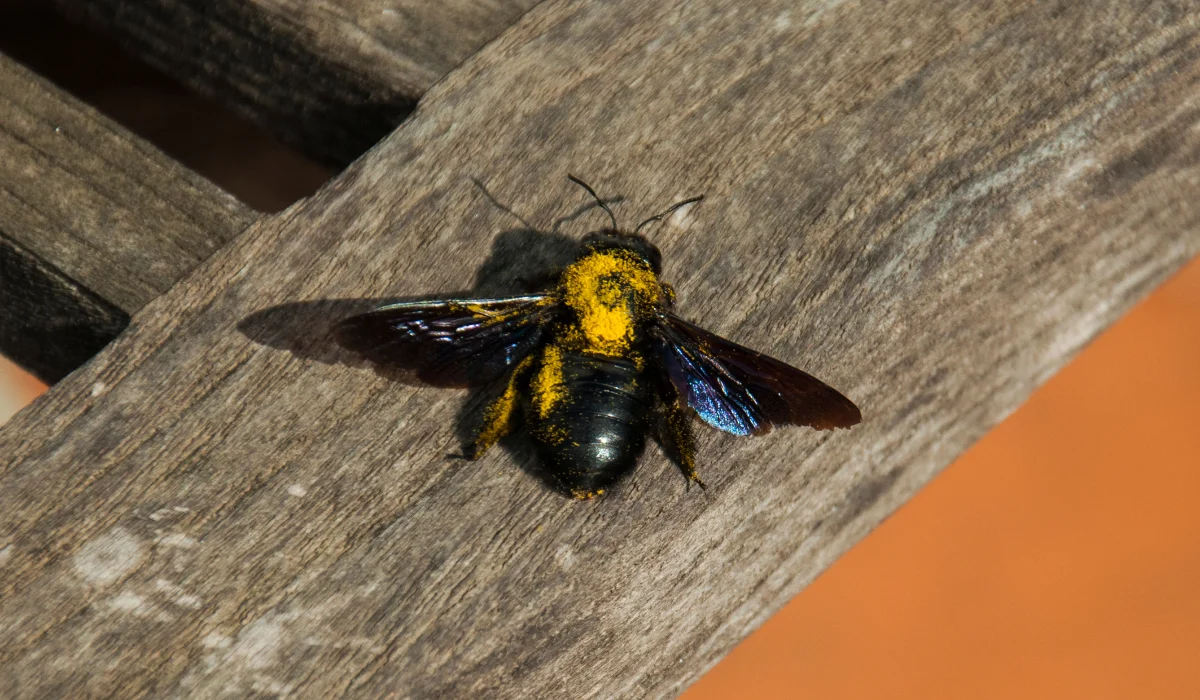
If you are seeing a large black bee hovering near a deck, porch, fascia board, or wood railing, it may be a carpenter bee. Homeowners sometimes assume they are seeing a queen, but carpenter bees do not live in colonies with queens the way honey bees or bumble bees do.
The insect causing wood damage is usually a female carpenter bee. She tunnels into wood to create nesting galleries, while males often hover nearby and act territorial. The main issue for Southwest Michigan homes is not a hive queen. It is repeated boring into exposed wood.
Key Takeaways
- Carpenter bees do not have queens like honey bees.
- Female carpenter bees bore into wood to make nesting tunnels.
- Male carpenter bees may hover aggressively, but they cannot sting.
- Round holes, sawdust, and yellow staining are common signs.
- Professional control helps when activity returns to decks, porches, and trim.
First, Carpenter Bees Do Not Have Queens Like Honey Bees
Carpenter bees are solitary bees. Each female can build her own nest by tunneling into wood. That makes them different from honey bees, which live in colonies with a queen, workers, and drones.
So when a homeowner says they saw a “queen” carpenter bee, they are usually describing a large female. She may be the one creating the tunnel, laying eggs, and returning to the same wood.
This distinction matters because control should focus on the nesting site and wood conditions, not on looking for a colony queen.
What Female Carpenter Bees Do
Female carpenter bees chew into wood to create galleries where they lay eggs. They do not eat the wood. They remove it to make space for the next generation.
You may notice activity around:
- Deck railings
- Porch ceilings
- Fascia boards
- Eaves
- Wooden trim
- Pergolas
- Fence posts
- Sheds
- Outdoor furniture
- Bare or weathered wood
Our guide to getting rid of carpenter bees in Michigan explains that carpenter bees often return to the same wooden structures year after year, which is why early control and wood maintenance matter.
Why Male Carpenter Bees Seem Aggressive
Male carpenter bees are often the ones homeowners notice first. They may hover near your face, patrol a porch, or dart around a deck. That behavior can feel intimidating, but males do not have stingers.
Female carpenter bees can sting, but they rarely do unless handled or directly threatened. The bigger concern around homes is usually wood damage, not frequent stings.
Still, avoid swatting, grabbing, or disturbing active holes. If you are allergic to stings or the activity is near children, pets, or entryways, keep distance and call for help.
How To Identify Carpenter Bee Activity
Carpenter bees are often mistaken for bumble bees. One useful clue is the abdomen. Carpenter bees usually have a shiny, black abdomen, while bumble bees are fuzzier across more of the body.
Look for these signs:
- Large bees hovering around wood
- Smooth, round holes in wood
- Sawdust-like material below openings
- Yellowish staining near holes
- Activity under eaves or porch ceilings
- Bees returning to the same spot
- Woodpecker activity near old tunnels
Pest Pros of Michigan’s honey bee and carpenter bee comparison notes that carpenter bee control should be paired with painting or sealing exposed wood to reduce future activity.
Why They Choose Certain Wood
Carpenter bees are more likely to target wood that is exposed, unfinished, weathered, soft, or easier to tunnel into. Protected underside areas can be especially attractive because the entrance is less exposed to rain and disturbance.
Common risk areas include:
- Unpainted wood
- Weathered deck boards
- Bare porch ceilings
- Old trim
- Soft or damaged boards
- Exposed fascia
- Wooden railings
- Outdoor structures with untreated surfaces
Painting, staining, sealing, and repairing exposed wood can help reduce the chance of repeated nesting.
Why Carpenter Bee Damage Can Return
One season of activity may look minor, but repeated use can make the problem worse. Carpenter bees may reuse and expand old tunnels, and new adults can return to the same general area.
Damage may increase when:
- Old holes are left open.
- Exposed wood is not sealed.
- Several females use the same structure.
- Woodpeckers peck at tunnels for larvae.
- Decks or trim stay weathered.
- Activity is ignored for multiple seasons.
The earlier the nesting site is confirmed, the easier it is to limit repeat activity.
What Homeowners Can Do First
If you see carpenter bee activity, start with observation. Do not plug an active hole before the issue is treated or inspected. Sealing bees inside can create other problems and may not stop the activity.
Helpful first steps include:
- Watch where bees enter and exit from a safe distance.
- Look for sawdust below round holes.
- Note whether the activity is near decks, eaves, or trim.
- Avoid handling bees.
- Keep children and pets away from active areas.
- Do not block holes while bees are active.
- Plan to repair and seal wood after treatment.
If the activity is high, hard to reach, or close to daily use areas, professional service is the safer route.
What Not To Do
Carpenter bee problems are easy to underestimate. A few holes can turn into repeat seasonal activity if the wood is not treated and maintained correctly.
Avoid these mistakes:
- Do not assume hovering males can sting.
- Do not grab or handle female bees.
- Do not plug active holes without a plan.
- Do not ignore sawdust or staining.
- Do not rely only on traps for an active nesting site.
- Do not leave bare wood exposed after service.
- Do not use indoor products on outdoor bee activity.
Correct identification and timing matter. The goal is to treat the nesting area, then reduce the chance of future boring.
How Pest Pros Of Michigan Handles Carpenter Bee Problems
Pest Pros of Michigan provides bee and stinging insect control for homeowners dealing with bees, wasps, hornets, and related activity around the home.
For carpenter bees, we focus on:
- Identifying the insect correctly
- Finding active nesting holes
- Inspecting exposed wood
- Treating problem areas when appropriate
- Explaining wood repair and sealing steps
- Helping reduce repeat activity in future seasons
Carpenter bee control is most effective when treatment and prevention work together. After service, exposed wood should be painted, sealed, repaired, or maintained so bees are less likely to reuse the same areas.
When To Call Pest Pros Of Michigan
Call us when carpenter bees are boring into decks, porches, trim, fascia, railings, sheds, or other wooden areas around the home. You should also call if the activity is close to doors, patios, children, pets, or areas used every day.
Professional service makes sense when:
- You see multiple round holes.
- Sawdust keeps appearing under wood.
- Bees return to the same structure each spring.
- The activity is high or hard to reach.
- You are not sure whether the insect is a carpenter bee or bumble bee.
- Woodpeckers are pecking at the same area.
- You want help preventing repeat damage.
We can inspect the activity, confirm what you are seeing, and recommend the right next step for your Southwest Michigan home.
Schedule Carpenter Bee Control In Southwest Michigan
If large bees are hovering near wood or round holes are showing up around your home, we can inspect the area and help protect the structure before activity spreads.
Contact Pest Pros of Michigan to request carpenter bee control in Southwest Michigan.
Frequently Asked Questions
Do Carpenter Bees Have Queens?
No. Carpenter bees are solitary bees and do not have queens the way honey bees or bumble bees do. Each female can create her own nesting tunnel.
Is The Large Bee Near My Porch A Female Carpenter Bee?
It may be. Female carpenter bees bore into wood and can sting if handled. Males often hover near nesting areas, but they do not have stingers.
Do Carpenter Bees Eat Wood?
No. They chew into wood to create nesting galleries, but they feed on nectar and pollen.
What Are The Signs Of Carpenter Bee Damage?
Look for smooth round holes, sawdust below the opening, yellow staining near the hole, and repeated bee activity around exposed wood.
When Should Southwest Michigan Homeowners Call Pest Pros Of Michigan?
Call when carpenter bees are boring into wood, returning to the same area, creating multiple holes, or nesting near decks, porches, doors, pets, or high-use outdoor spaces.

 Serving Michigan since 2018
 Pest-free guarantee
 Small, local business
 10+ years of pest control experience
 President and CEO of Pest Pros of Michigan
 Resident of Michigan